
HMHS Britannic Home

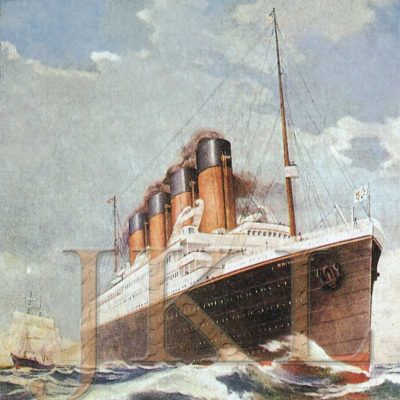
Before the Great War started, White Star’s publicity department began to advertise their new, gigantic liner Britannic, the younger sister of the lost Titanic. This illustration shows the Britannic as she would have appeared, had she been completed for peacetime service. (J. Kent Layton Collection)
| Ship Statistics: | |
| Built By: | Harland & Wolff |
| Yard Number: | 433 |
| Length Overall: | 882 feet 9 inches |
| Length Between Perpendiculars (b.p.): | 850 feet 0 inches |
| Width: | 94 feet 0 inches |
| Draught: | 34 feet 7 inches |
| Gross Tonnage: | 48,158 |
| Displacement: | <53,100 tons at 34 feet 7 inches |
| Career: | November 13, 1915-November 21, 1916 – Sank |

The History of the HMHS Britannic – A Brief Look:
The third and final entrant of the Olympic-class trio was the vessel that we now know as the Britannic. She started life as Harland & Wolff Yard No. 433, and it seems that her original name may have been intended as Gigantic[*]. However, by the time she entered service, she was a very different ship than her original plans had called for, and she also bore the name Britannic.
The Britannic‘s first keel plate was laid on November 30, 1911 and work had not progressed far before the Titanic sank the following spring. All work on the third ship was put on hold pending the outcome of the Inquiries into the loss of the Titanic. When all was said and done, it became obvious that the new ship would need to be significantly altered in order to comply with post-Titanic safety requirements. Her transverse bulkhead subdivision was changed through the division of the Electric Engine Room and the raising of five critical bulkheads to the height of B Deck. An inner skin was also added, padding the important Boiler and Engine Rooms. Because of her increased beam and other design changes, her displacement did increase from that of her preceding sisters, coming in just under 53,200 at a draught of 34′ 7″. (At this same draught, the Olympic and Titanic each displaced 52,310 Imperial Tons of 2,240 lbs each.)
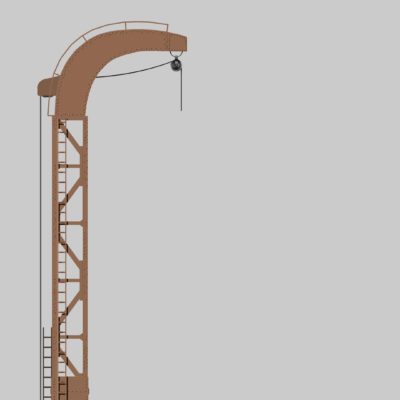
Above, large “gantry”-style davits were installed to carry the ship’s complement of forty-eight extra-large lifeboats. (Note: For a discussion of the intended number of R.M.S. Britannic’s lifeboats, please see the article found here.) There would be eight sets of these davits, all told: one on either side of the forward funnel, two on either side of the aft funnel, and two astern on the Shade Deck. (Only five sets had been installed when the ship entered service as a hospital ship.)
Improvements in the liner’s First Class accommodation were also intended, but in the end she would never see commercial service. The ship was launched on February 26, 1914 and was still fitting out when the Great War began.
Although many improvements were made to the Britannic over her older sisters, and her breadth was increased from theirs, one thing that did not change between the three sisters was their length between perpendiculars and their length overall. All three Olympic-class ships shared identical frame numbering and spacing, and bore the same fore-aft dimensions: 850′ 0″ bp, and 882′ 9″ oa.
On November 13, 1915, she was formally requisitioned as His Majesty’s Hospital Ship Britannic. Apparently – according to the very latest research on the matter – she was given the Transport Identification Number G608.
She made three voyages to the Mediterranean in this guise, and was then laid up on April 12, 1916. On August 28, 1916, the ship was recalled to active service. At this point, it seems likely that the ship was given her new Transport Identification Number, G618. The Britannic made two further voyages to the Mediterranean. She set off on her sixth voyage from Southampton on November 12, 1916. On November 21, she struck a mine in the Aegean Sea and sank in must 55 minutes – despite all of her safety improvements after the Titanic disaster.
Only thirty of the nearly eleven hundred on board died in the sinking,[#] and most of those died when several lifeboats were launched prematurely and were sucked into the still-turning propellers. Ironically, the Britannic is much better preserved and much more accessible than her older, more famous sister Titanic. Because of increased interest in the Titanic during recent years, a surge of interest in all of the Olympic-class ships – including the Britannic – has been noted of late. Now, Titanic‘s “forgotten sister” is no longer forgotten.
[*] Admittedly, this is a hotly-debated topic. Jonathan Smith, a trustee of the Titanic Research & Modeling Association (TRMA), has discovered evidence helping to confirm that the ship was known – at least in some circles within the shipbuilding industry, not just in press articles – as Gigantic. The article may be read here. Mark Chirnside and Paul Lee have also authored an excellent article on the subject, entitled: “The Gigantic Question,” published in The Titanic Commutator, issue No. 180. Please also see The Olympic-Class Ships, by Mark Chirnside, 2011 Edition, pages 224, 225.
It is important to note that the earliest known official Harland & Wolff reference to the name of Yard No. 433, in their order book, was for the name Britannic. On 30 May 1912, the White Star’s parent company, Ismay, Imrie & Co., formally requested of the Board of Trade that the name Britannic be reserved for their use.
From all this, it seems possible that the name Gigantic was originally considered, but may never have been formally settled upon; the lack of official denials of this name from Bruce Ismay or others, before the Titanic disaster, may indicate that the name Gigantic was originally intended, but nothing had been put to paper on the point, and that it was quickly changed after the Titanic disaster.
According to official documentation found up to this date, however, ship 433 was always to be called Britannic.
[#] Although the official log of the Britannic cited 30 total casualties (21 crew and 9 RAMC personnel), a number of people who initially survived died in the weeks, months or years after the disaster due to injuries sustained in the sinking. Please see Mark Chirnside’s book, The ‘Olympic’ Class Ships: Olympic, Titanic Britannic (The History Press, 2011, Appendix Fourteen for further details.
Britannic Gallery:


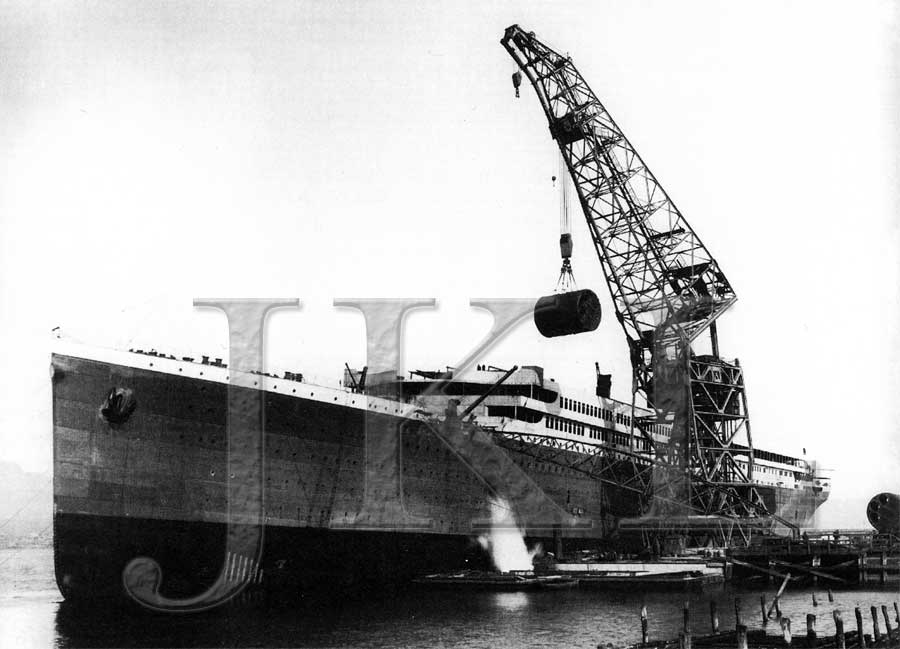
![Two builders' models, one of the 1914 Britannic [at left], and one of her namesake, the first Britannic, on the right. (J. Kent Layton Collection)](https://atlanticliners.com/wp-content/uploads/2016/11/Britannic-Model-large-400x400.jpg)
![Two builders' models, one of the 1914 Britannic [at left], and one of her namesake, the first Britannic, on the right. (J. Kent Layton Collection)](https://atlanticliners.com/wp-content/uploads/2016/11/Britannic-Model-large.jpg)




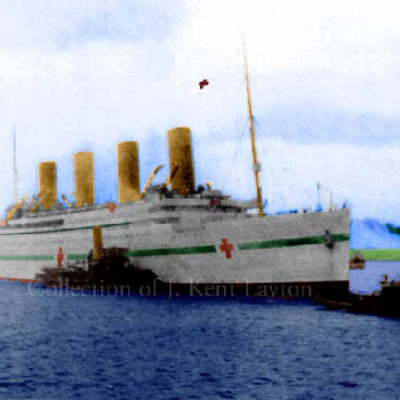

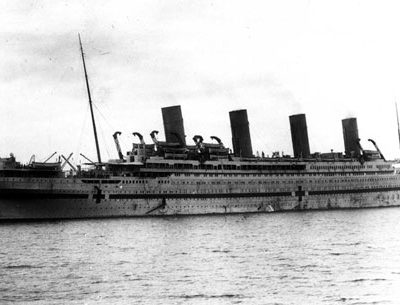

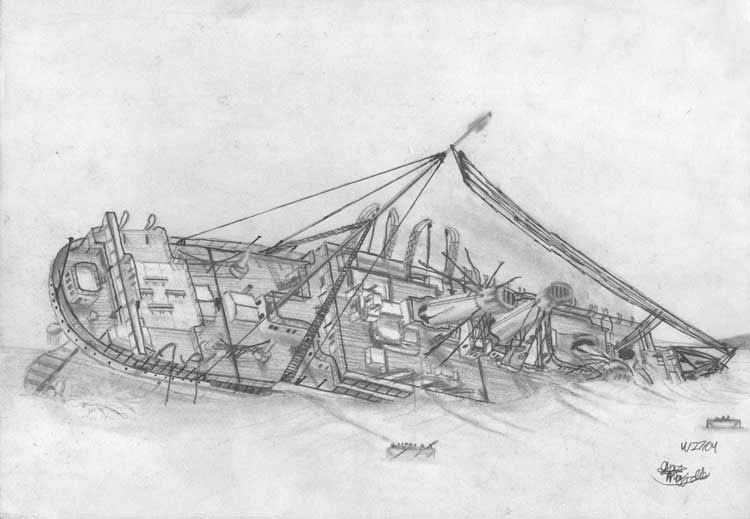
| The Controversy: G608 or G618
Insight Into the Enigma |
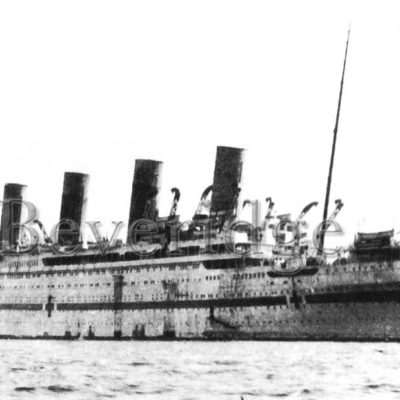
For years, historians believed that the HMHS Britannic‘s Transport Identification Number was G618 throughout her service in that guise. However, a little over a decade ago, a startling image was published for the first time. It clearly showed that the Transport ID plaque beneath her Bridge read: “G608”. The photograph was later included in my own book, The Edwardian Superliners: A Trio of Trios.
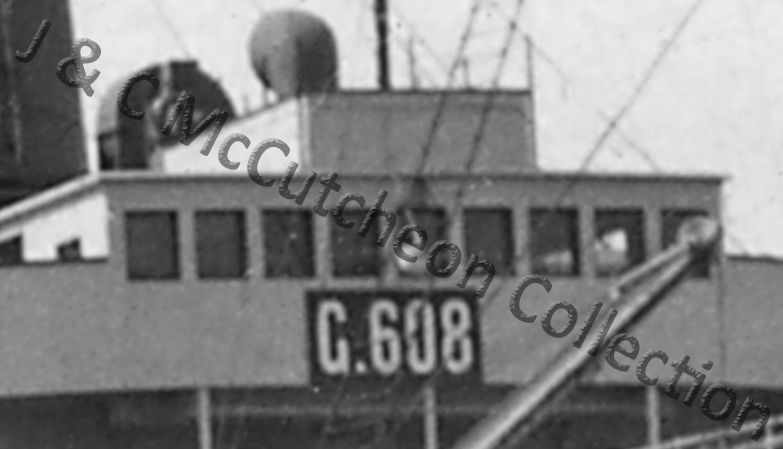 This photograph shows the Britannic‘s Transport ID Number to be G608, not G618 as originally thought. The photo was taken in early 1916, during the liner’s first stint in that guise. – J. & C McCutcheon Collection.
The emergence of this photograph led to questions: Why was there no previous official documentation of the G608 number? Was the Britannic ever actually identified as G618?
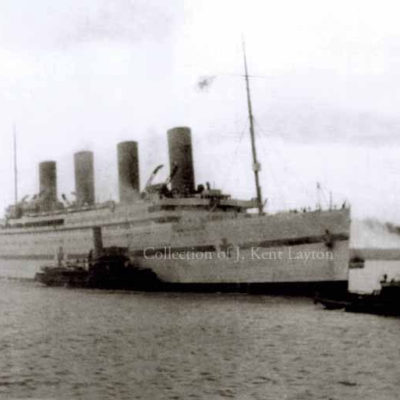
Then Britannic historian and enthusiast Michail Michailakis of the website Hospital Ship Britannic acquired another photograph of the vessel, taken in October 1916 at Mudros Harbor.
 Above is the full photograph. (Michail Michailakis Collection) Below is an enlargement of the area in question.
As this enlargement shows, the number plainly switched from G608 to G618 at some point during her career. It seems most likely that this occurred after her spring/summer 1916 layup, although there are other possibilities.
My sincerest thanks to Mr. Michailakis for his kind permission to use this photograph for further availability to the public. Please do not save, repost, reshare, or reprint it without the permission of Mr. Michailakis.
Britannic artwork by William Barney:
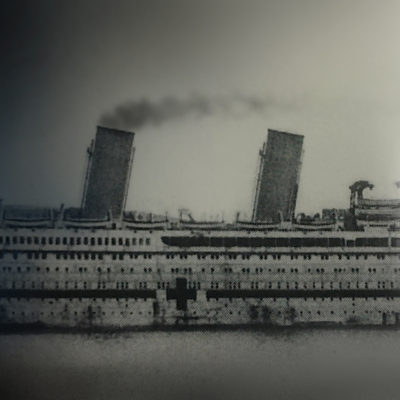
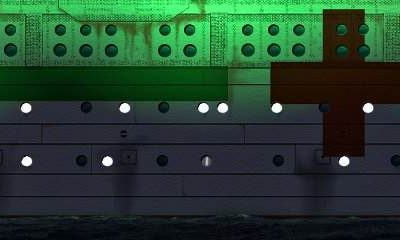
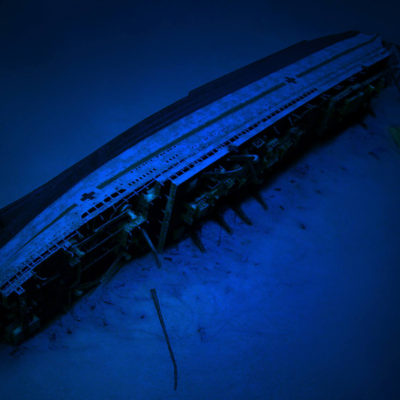
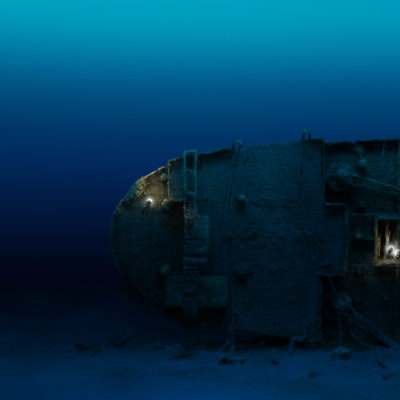
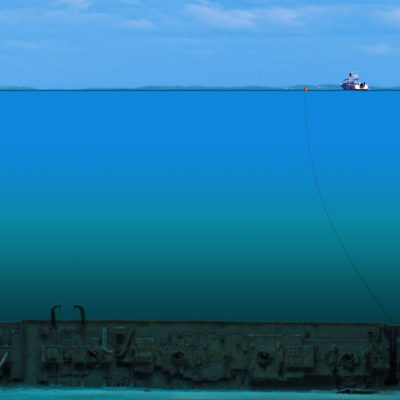
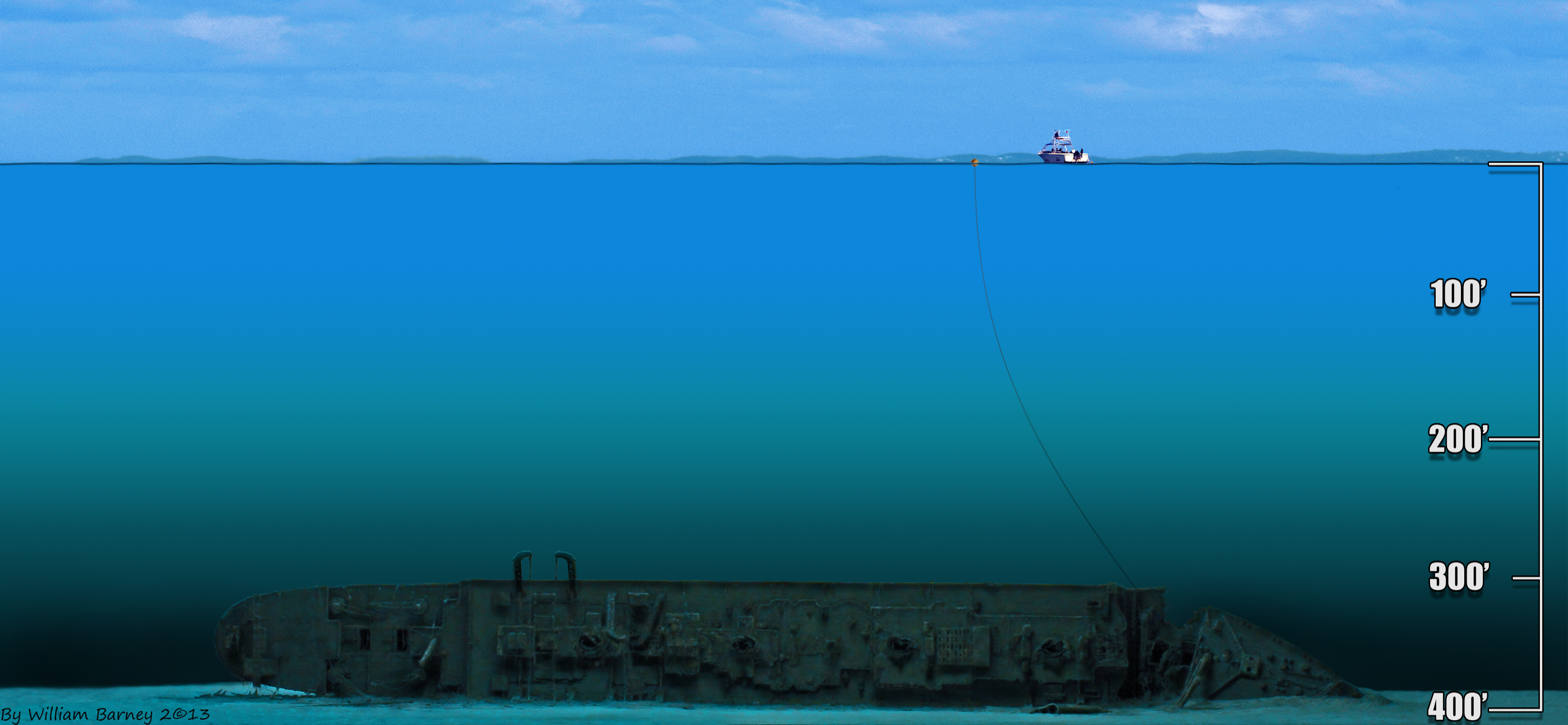
In honor of the centennial of the sinking of the HMHS Britannic, liner enthusiast and artist William Barney has kindly given me permission to display his fantastic artwork. My sincerest thanks to Mr. Barney.











Britannic artwork by Tony Strublic, maritime artist:
The very talented artist Tony Strublic has shared these three original pieces with me for display.


Britannic artwork by Neil Egginton:
Britannic enthusiast and artist Neil Egginton has shared with me these fine pieces of artwork to display here.


Voyages of the HMHS Britannic (mm/dd/yyyy): |
||||
| Voyage No. 1: Departed Liverpool 12/23/1915; – arrived Mudros 12/31/1915; – docked Southampton 1/9/1916 |
||||
| Voyage No. 2: Departed Southampton 1/20/1916; – arrived Naples 1/25/1916; – returned to Southampton 2/9/1916 |
||||
| Voyage No. 3: Departed Southampton 3/20/1916; – arrived Naples 3/25/1916; – returned to Southampton 4/4/1916. – Note: Stopped at Augusta before returning to Southampton. |
||||
| Laid up: 4/12/1916 Discharged: 6/6/1916 Returned to builders: 5/18/1916 Belfast Recalled: 8/28/1916 |
||||
|
Voyage No. 4: |
||||
|
Voyage No. 5: |
||||
|
Voyage No. 6: |
Ship’s Officers, HMHS Britannic
|
|
| Captain | Charles Alfred Bartlett |
| Assistant Captain | Harry William Dyke |
| Chief Officer | Robert Hume |
| First Officer | George Ernest Kemp Oliver |
| Second Officer | Alfred Brocklebank |
| Third Officer | Francis W. Laws |
| Fourth Officer | Duncan Campbell McTavish |
| Fifth Officer | Gordon B. Fielding |
| Chief Engineer | Robert Fleming |
| Chief Purser | Claude Lancaster |
| [*] A full listing of Britannic‘s officers throughout her career can be found on Mark Chirnside’s site here. | |
Those Aboard BritannicNovember 21, 1916 |
|
|
Crew |
673 |
| RAMC Staff | 313 |
| Nurses | 76 |
| Total | 1,062 |
| Survivors | 1,032 |
| Casualties | 30 (21 crew, 1 officer, 8 RAMC) |
Alternate Tallies of Those Aboard BritannicNovember 21, 1916 |
|
| Version 2 Announced by the Admiralty through The Times of London: |
|
| Crew | 625 |
| Officers | 25 |
| Nurses | 76 |
| Orderlies | 399 |
| Total | 1,125 |
| Version 3 Shipping Casualties Register, December 7, 1916 |
|
| Crew | 673 |
| Surgeons | 22 |
| Chaplains | 3 |
| Nurses | 77 |
| RAMC Orderlies | 299 |
| Total | 1,074 |
The Sinking of the HMHS Britannic – In Real Time
A special treat was released for the centennial anniversary of the Britannic disaster: the group behind the construction of the new, hyper-accurate video game Titanic: Honor and Glory, have released a new documentary on the sinking of the Britannic, which runs in “real time”, meaning that you get to watch the disaster play out over the course of precisely 55 minutes, while narrators give detailed information on what was happening, and audio actors read accounts from actual survivors. The results are breathtaking.
The Britannic is no longer a forgotten ship, thanks to the popularity of her sister, Titanic. However, due to her short life and the realities of the war she was born in to, there are very few photographs of the great ship that have survived. These fantastic graphic renderings of the Britannic have been created by graphic artist Christian Stenfelt. They show the great ship in all her glory, and highlight some of the differences between the Britannic and her older sisters.
Please click here to return to the Olympic‘s Home Page.
Please click here to return to the Titanic‘s Home Page.