
RMS Lusitania Home

Lusitania on her trials. (J. Kent Layton Collection.)
| Ship Statistics: | |
| Built By: | John Brown & Company |
| Yard Number: | 367 |
| Length Overall: | 787 feet [*] |
| Length Between Perpendiculars (b.p.): | 760 feet 0 inches |
| Width: | 87 feet 6 inches |
| Draught: | 33 feet 6 inches |
| Gross Tonnage: | 31,550.47 registered |
| Displacement: | 44,060 registered |
| Career: | September 7, 1907-May 7, 1915 – Sunk by German submarine U-20. |
The History of the RMS Lusitania – A Brief Look:
The keel of the Lusitania was laid down on Wednesday, August 17, 1904, at the shipyards of John Brown & Co. on the River Clyde in Scotland. She was slated to be not only the world’s largest largest, but also the world’s fastest liner when she entered service, and because of this, the shipyard was truly working in uncharted territory. Many of the “firsts” incorporated into this liner – including a quadruple-screw layout, marine steam turbines, and a host of other features – would be seen again on later liners, including the Aquitania, Queen Mary, Queen Elizabeth and many others.

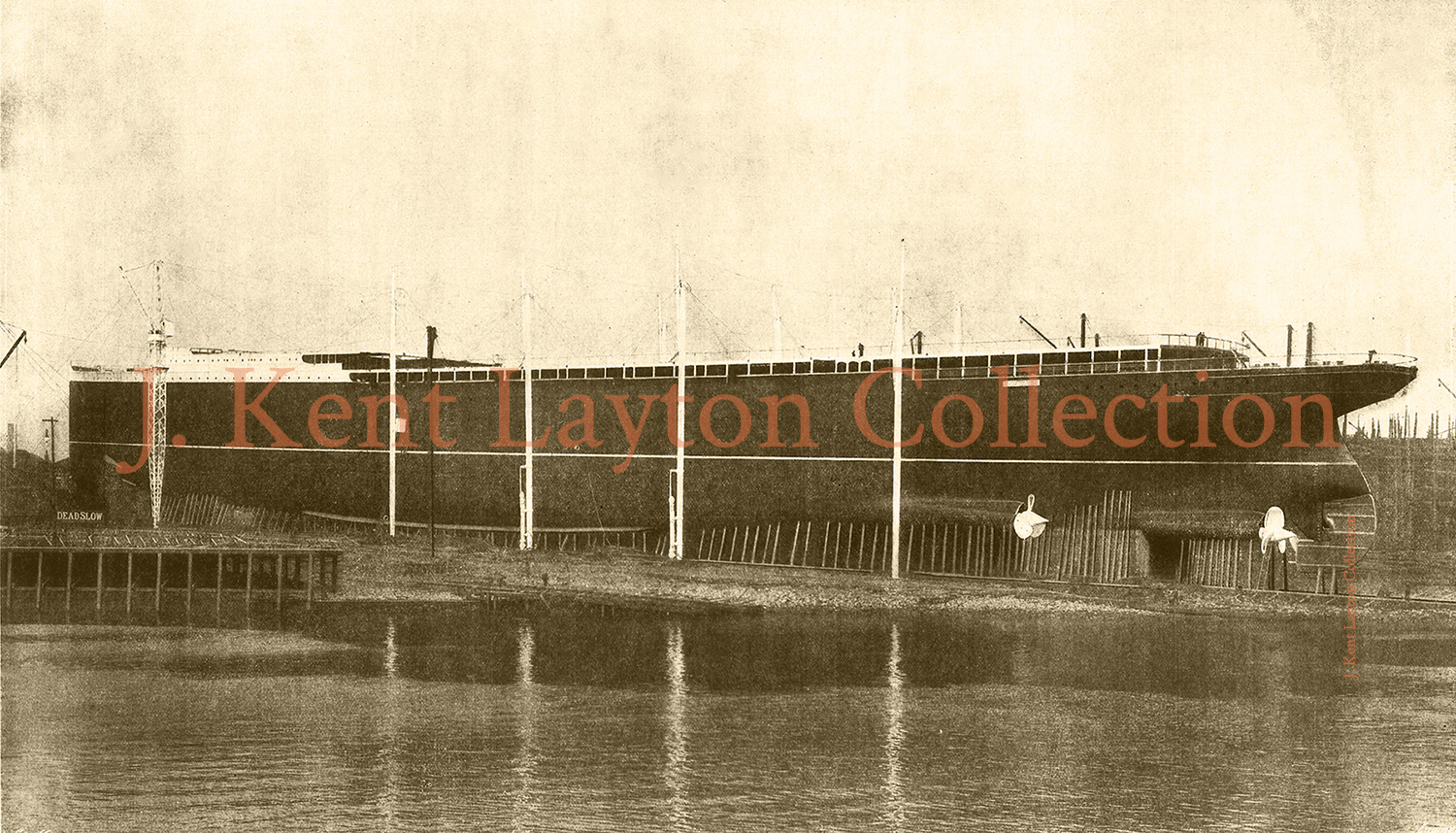
The stern of the Lusitania towers over the ways at the John Brown shipyard shortly before her launch. (J. Kent Layton Collection)

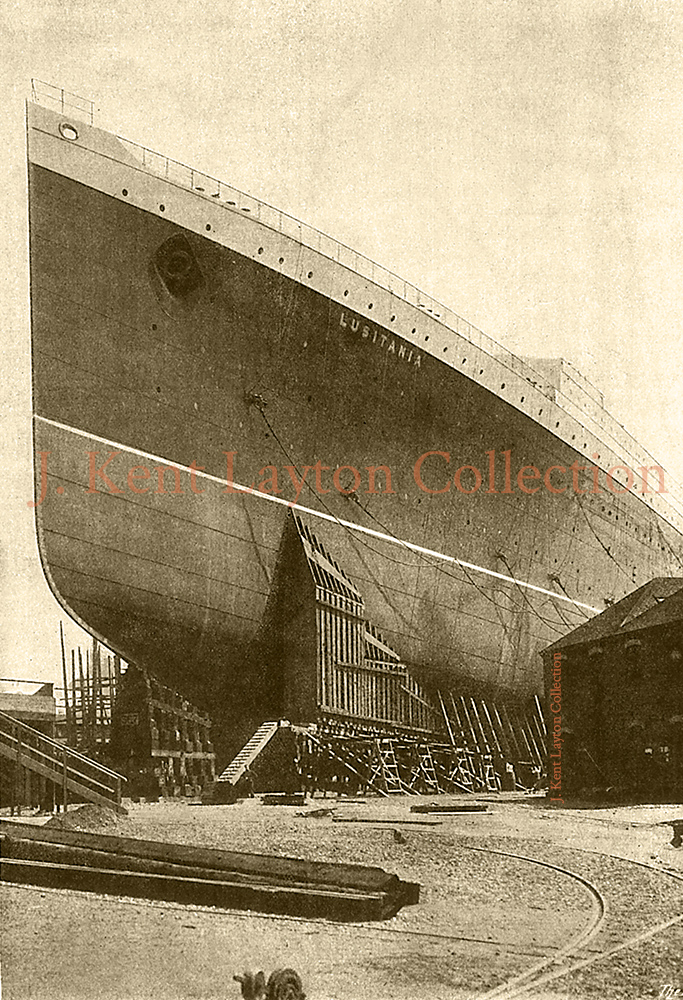
The bow of the Lusitania, nearly ready for launch, towers over the John Brown shipyards on the River Clyde. (J. Kent Layton Collection)

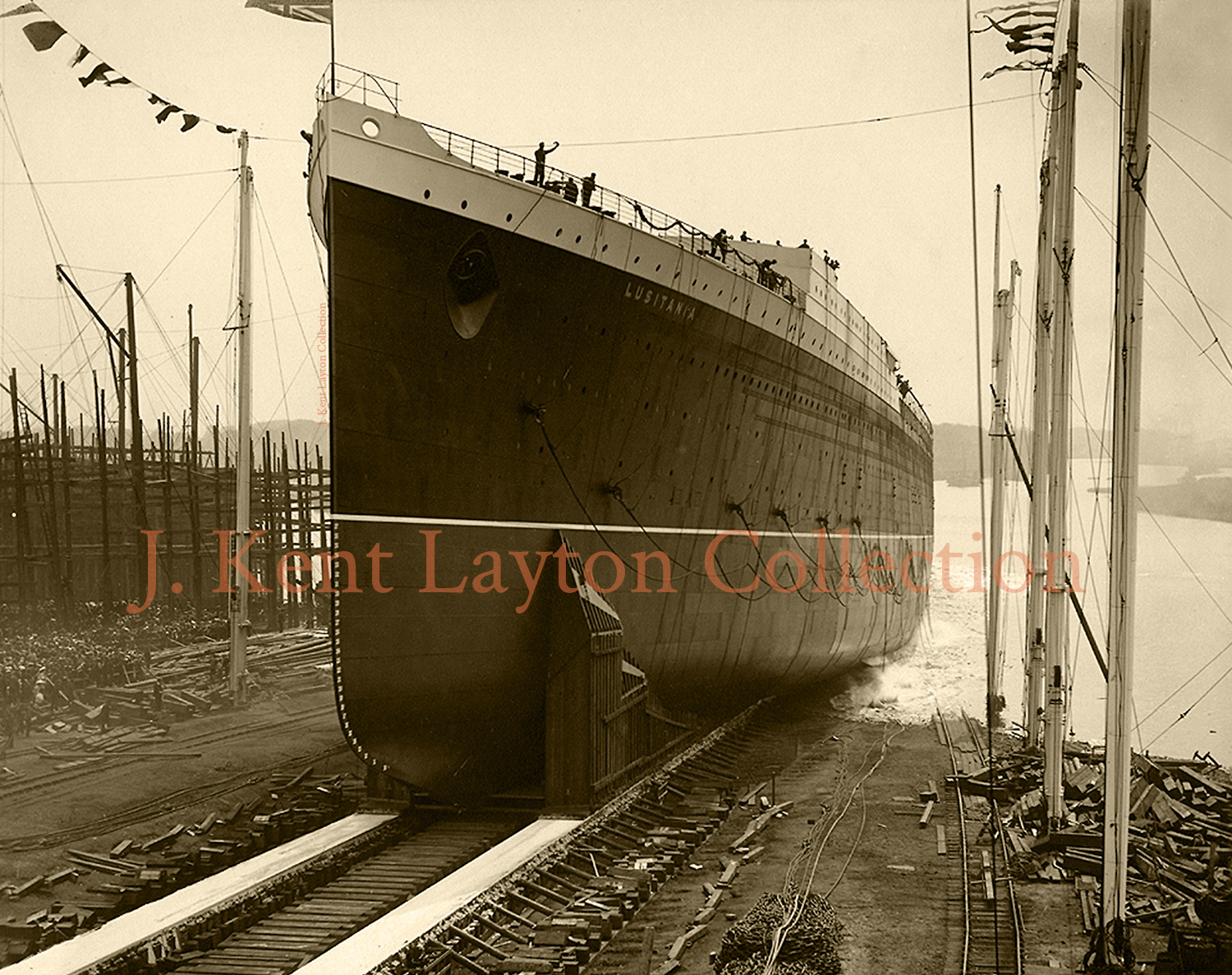
The ship sits on the ways, with her propellers in place, as the launch date of June 7, 1906 approaches. (J. Kent Layton Collection)
Lusitania was launched on Thursday, June 7, 1906, in that moment becoming the largest moving object in the world. Her sister, Mauretania, would lay claim to that title when she was launched, because she was slightly longer and wider. (On the other hand, the Titanic did not have such a distinction when she was launched in 1911, as her older sister Olympic was of an identical length, width and weight [52,310 tons registered]) However, the Lusitania could still lay claim to the title of “world’s largest liner” when she entered service in September of 1907, because the Mauretania did not enter service until November of that year.
Lusitania served the Cunard Line with distinction between that summer and the spring of 1915. During that career, she accrued an exciting array of firsts, records, storm stories and other notable events.

A photograph of the Lusitania steaming off the coast of Ireland, just a few miles from where she was eventually sunk. In this photograph, a relatively rare view held in my personal collection, the ship is steaming west-bound; the photo was taken around 1911. (J. Kent Layton Collection)
Although her younger sister Mauretania proved slightly longer, larger, faster (permanently taking all speed records from the Lusitania in 1909) and – contrary to popular opinion – more popular than the Lusitania, the older ship built a solid reputation for reliability and safety, and became a much-beloved fixture in both Liverpool and New York. (All of the aforementioned details are discussed, in great detail, in Lusitania: An Illustrated Biography.) Although the Olympic and Titanic eclipsed the Lusitania and Mauretania in size, the Cunarders still had a decided advantage of their competitors in terms of speed and reputation. Particularly after the sinking of the Titanic in April of 1912, the Lusitania and Mauretania seemed to have bright futures on the North Atlantic.
Beginning in June of 1912, the Lusitania began to suffer a protracted series of difficulties with her revolutionary turbine engines. In mid-October, she was removed from service for repairs, and did not re-enter service until December 13.

This marvelous photograph of the Lusitania was taken in New York during her single stay there between December 21 and 24 of 1912. This was after her two-month layup for turbine repairs, and just before her turbines suffered catastrophic failure. She would not return to New York again until August 30, 1913, over eight months from the time this photo was taken. It is clear that snow had fallen after the ship’s arrival, as it has accumulated on her upper decks. A crewman tends to one of the Bridge windows. The picture shows that, since her entry into service, a number of changes had been carried out on the ship’s ventilator system. Some of the original cannister-style vents had been replaced with Mauretania-esque cowl ventilators, which had proved sturdier. Extra lifeboats, brought aboard after the sinking of the Titanic that previous spring, can be seen on the Boat Deck. Extra davits would be installed later in the ship’s career. – (Library of Congress, Prints & Photographs Division, Author’s Collection [Restoration by J. Kent Layton])
On December 30, 1912, the Lusitania‘s turbine machinery experienced catastrophic failure after a near-collision in Fishguard, Wales. Extensive repairs were carried out at the John Brown shipyards, and the ship was out of commission until late August of 1913. During the next year, she continued her service, but during the summer of 1914, the world changed forever.
After the outbreak of World War One, many of the Atlantic liners were either tapped for Government service or were laid up, and in short order, the Lusitania was the only crack liner left on the Liverpool-New York route. As demand for passenger traffic had fallen off significantly during the fall/winter of 1914/1915, her operation was economized. This was accomplished by closing one of her four Boiler Rooms down; this caused a reduction in her top speed from 25+ knots to 21, but at the time, this was not considered a threat to the ship’s safety; all German naval forces and converted merchant marine auxiliaries had either been bottled up in German waters or had been removed from action by the Royal Navy in the early days of the conflict.
At the time, submarines had not really been proven as a strong force in naval warfare. However, with its primary force bottled up, the German Navy quickly learned how to use these vessels effectively. Following the old-fashioned “cruiser rules”, the submarines commenced a “gentleman’s” campaign against the British merchant shipping. A “War Zone” was declared in the waters surrounding the British Isles in early 1915, and British and neutral merchant vessels were warned against sailing into this “War Zone”, but the traffic continued and ships like the Lusitania continued to ply the waters between England and America.
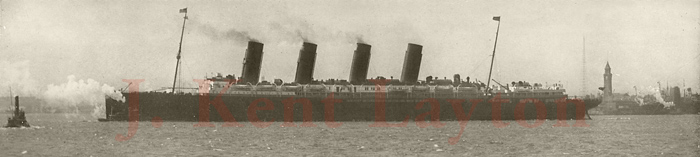
A beautiful port profile of the Lusitania departing New York during the winter months of 1914-1915. (J. Kent Layton Collection)
As the number of merchant ships sunk by the U-boats began to rise sharply, concern grew for their safety among those in the Admiralty and Parliament. Anti-submarine tactics were in their infancy and were highly ineffective. The Admiralty began to issue a series of orders and advices to the Captains of British merchant vessels like the Lusitania in an effort to steer them clear of U-boats. Coded transmissions were also sent out via wireless with the latest updates to all ships inbound to the “War Zone”. It was hoped that these measures, when combined with the good leadership of merchant skippers, would cut down on the losses. Tactics like steaming at full speed through the “War Zone”, avoiding headlands – where U-boats lurked – and steering a zigzag course came into practice. (Indeed, in August of 1914, Captain Haddock of the Olympic implemented such tactics while she was inbound to Liverpool.)
On May 1, 1915, the R.M.S. Lusitania departed New York on her 202nd crossing of the Atlantic under the command of Captain William Turner. The crossing would end in disaster on May 7 off the south coast of Ireland …
At 2:10 p.m., a single torpedo struck the liner’s starboard bow. Because of certain deficiencies in the watertight subdivision of the liner in that area, this single blow was enough to sink the ship. A second – and highly controversial – explosion took place shortly thereafter. Eighteen minutes after the blow was struck, the mighty Lusitania slid beneath the waves. 1,198 innocent men, women and children lost their lives.
MARKING THE ANNIVERSARYof the Lusitania disaster. |
|
|
Thus to equate to modern clocks keeping Daylight Saving Time, the exact anniversary of the sinking takes place on May 7 at 8:10 a.m. New York Time, 1:10 p.m. GMT, and 2:10 p.m. Berlin Time. |


This period artist’s depiction shows the Lusitania sinking off the Old Head of Kinsale on May 7, 1915. It captures some of the most dramatic elements of the event with startling vividness. (J. Kent Layton Collection)
The Stokes Family—Aboard for the Last Crossing |
|
|
“The Stokes had planned to travel to England, to see Mr. Stokes’ family. Their son was approximately 2 yrs. old and they were expecting another child. The family in Victoria cautioned them against the journey, but the young couple were fearless. “Mabel Stokes wrote a series of letters to her family in Victoria, as they journeyed by train to New York. The letters, of course, arrived after the sinking of the Lusitania. Sadly, the last words of the last letter were:
The Daily Colonist of May 8, 1915, headlined the loss of the Lusitania on its front page with the headline: “Submarine Gets Over 1,400 Victims”. Under the article, “Victorians Who Were Aboard,” the following information is included:
Did you enjoy this account of passengers who were aboard the Lusitania during her fateful voyage? If so, then you will certainly want to read the two part series, “Lest We Forget,” written by Jim Kalafus and Mike Poirier, maritime historians who have put much research into the history of the Lusitania, and who kindly provided an introduction for my book, Lusitania: An Illustrated Biography. Follow these hyperlinks to the articles: |


Above: The Lusitania (left) and Mauretania (right) pass each other in the Mersey in this pre-1912 photograph. Both ships are dressed out, saluting each other. They were the pride of the Cunard fleet, the two largest ships in the world (until the Olympic of 1911), as well as the two fastest. (J. Kent Layton Collection)
Senior Officers of the Lusitania, Crossing 202, May 1-7, 1915: |
Souls on Board Lusitania, Crossing 202, May 1-7, 1915: |
|||
|
Captain |
William Thomas Turner, Commodore |
First Class: |
290 |
|
|
Staff Captain |
James Clarke “Jock” Anderson |
Second Class: |
600 |
|
|
Chief Officer |
John P. Piper |
Third Class: |
367 |
|
|
Chief Officer (2nd) |
John Stevens |
Male Passengers: |
688 |
|
|
First Officer |
Arthur Rowland Jones |
Female Passengers: |
440 |
|
|
Second Officer |
Percy Hefford |
Children: |
90 |
|
|
Senior Third Officer |
John Idwall Lewis |
Infants: |
39 |
|
|
Junior Third Officer |
Albert R. Bestic |
Total Number of Passengers: |
1,257 |
|
|
Chief Engineer |
Archibald Bryce |
Crew: |
702 |
|
|
Total Souls on Board: |
1,959 |
|||
Lusitania Gallery
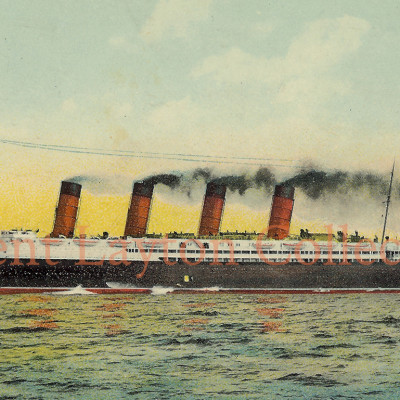
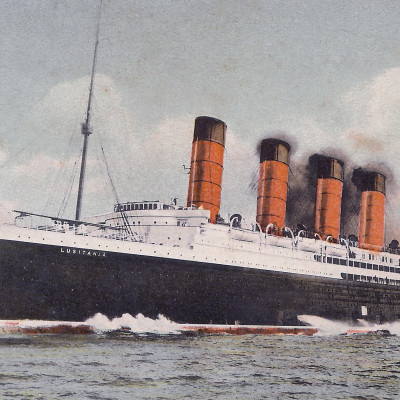
A selection of Lusitania images for you to enjoy.







|
Below are a number of frequently-asked questions regarding the history of the Lusitania. Please click the one that interests you, and after reading the material click the “Back to top” link to come back to this list of questions.
- Wasn’t the length of the Lusitania 785 feet?
- What was the actual date that the Lusitania was launched? I’ve read conflicting information on this.
- What was the actual date that the Lusitania‘s keel was laid? I’ve read conflicting information on this.
- Were the Lusitania and the Mauretania really sister ships?
- Was the Lusitania carrying contraband on her last crossing?
- Did the Lusitania‘s contraband cargo cause the mysterious second explosion, and if so did it hasten the ship’s demise?
- Where did the torpedo strike the Lusitania?
- Did Captain Turner receive unfair blame for the sinking?
- Was the British Government, including First Lord of the Admiralty Winston Churchill, involved in a plot to have the Lusitania sunk in order to bring the United States into the war on their side?
Q: Wasn’t the length of the Lusitania 785 feet?
A: No. Her length between perpendiculars (or length b.p.) was 760’ 0”; from the forward perpendicular (or f.p.) to the furthest point forward of the stem was 2.2’; from the after perpendicular (or a.p.) to the taff rail was 25’. 760’ + 25’ + 2.2’ = 787.2’. A direct measurement of the ship’s original blueprints, and calculations based on her frame spacing, confirm the ship’s overall length to be 787.2 feet. This figure is also confirmed by original documents from the shipbuilder, John Brown & Co., Ltd.
The Mauretania shared an identical length b.p., and the same 2.2 feet of length from the forward perpendicular to the tip of the stem; her overall length, however, was 790 feet, with the extra length being carried aft of her after perpendicular.
 Nor is the 787-foot determination a new figure. Over and over again, in both newspapers and trade technical journals, the figure 787 feet was applied to the overall length of the Lusitania, or – before the Mauretania‘s final dimensions were determined – were applied to both vessels. This happened far too often to be easily dismissed. Interestingly, an early post card of the Mauretania, held in the author’s collection, extrapolates the overall length of the Mauretania based on the overall length of the Lusitania. Although incorrect for the Mauretania, the figure lends weight to the concept that 787 feet was not an unknown figure, even in 1907, for the overall length of the Cunarders:

So after this, we are left with the nagging question: Where did the 785′ figure come from? Apparently, some prestigious journals of the time quoted the figure, and it was picked up and repeated many times thereafter from researchers who relied upon those journals.
Back to top.
Q: What was the actual date that the Lusitania was launched?
A: The actual launch date of the Lusitania is confirmed as Thursday, June 7, 1906, not the “June 6” which is frequently mentioned. The June 7 date is shown in numerous original sources, including The New York Times of the following day. The June 6 error has been perpetuated from some books on the subject, and is often repeated in various online encyclopedias like Wikipedia.
Back to top.
Q: What was the actual date that the Lusitania‘s keel was laid?
A: The Lusitania‘s keel was laid on August 17, 1904. How do we know this? This information has been shrouded in mystery for decades, as there are any number of dates provided for the laying of the Lusitania‘s keel. These include: June 16, 1904, August 17, 1904, September 1904 and spring of 1905. It is remarkable that for so many years, such an important date in the ship’s history has been the subject of such confusion, but considering the mistaken launch date provided in many sources, it was perhaps to be expected. Because the name “Lusitania” was not given to John Brown Yard No. 367 until 1906, it is very difficult to search through period journals for any mention of work commencing on her. However, a number of references to her construction having commenced appeared before the summer of 1904 was out. These references ruled out the spring of 1905 date, and cast a dim light, indeed, on the September of 1904 date. This left two remaining dates: June 16 and August 17, 1904.

The keel of the Lusitania, or Hull 367 as she was then known, taking shape at the John Brown & Co. shipyard. (J. Kent Layton Collection)
Actual archival evidence, once found, actually showed that the correct date for this step of the liner’s construction took place on August 17, 1904. Interestingly, the keels for both the Lusitania and the Mauretania were laid before the formal contracts for their construction were signed; that event did not occur until May of 1905.
Back to top.
Q: Were the Lusitania and the Mauretania really sister ships?
A: The short answer to this is yes. The longer answer depends on how strictly you would define the term, “sister ships.” Some have tartly pointed out that because the two vessels were of differing lengths, were built in different yards, and had variations in their final designs, they were in no way “sisters.” However, one is forced to wonder: if the two vessels were not sisters, what, indeed, were they?
The Olympic and Titanic, by comparison, are always called “sister ships,” even though they were non-identical in finished form. Even more interesting is the fact that the third of that trio, Britannic, is also included as a “sister” to the first two White Star giants, despite enormous alterations from her predecessors.
Looking at the Cunard pair, although the Lusitania and Mauretania were built at separate shipyards, they were drawn up from one original concept, just like the Olympic and Titanic. They were also designed to complement each other in a sister-like service, running the Liverpool – New York run. Additionally, they were constructed nearly simultaneously, and entered service within months of each other. Period statements and writings about the two vessels also almost universally referred to them as “sisters.”
So were the Lusitania and Mauretania sisters? The answer to this question seems logical enough to grasp: yes. They would never, however, be called “twin” sisters, just as the Olympic and Titanic were not “twin” sisters.
Back to top.
Q: Was the Lusitania carrying contraband on her last crossing?
A: Yes. Even a cursory glance at her cargo manifest shows that almost everything in her cargo holds was absolute contraband under the British definition of such by the early spring of 1915. As a British merchant vessel, carrying contraband (including non-explosive munitions destined for the fronts) through a formally declared War Zone, in legal terms the Lusitania became a blockade-runner, a legitimate target of war for any prowling German U-boat despite the civilians she carried.
Back to top.
Q: Did the Lusitania‘s contraband cargo cause the mysterious second explosion, which hastened the ship’s demise?
A: No. There is a lot of information on this subject contained in my work, Conspiracies at Sea: Titanic & Lusitania (November 2016, Amberley Books), and I would recommend that you pick up a copy of that book for the full details. However, a brief summary is appropriate here.
For starters. the ammunition aboard almost certainly did not cause the blast, because it had been proven long before the sinking that this type of war material would not explode en masse even if it was exposed to an open fire for extended periods; about the worst that would happen is the individual shells might “cook off”, but without even damaging the outer containers.
There have been allegations about “secret” cargo ‘disguised’ as furs, cheese, oysters, etc., but these allegations have been proven baseless; for example, furs washed up on the Irish coast after the sinking, proving that they were authentic. Aluminum fine powder has also been pointed to as a possibility for this blast; however, the conditions needed to induce this powder to explode – even if it was aboard – simply were not present at the time. The cargo holds where these items were stored have been inspected by numerous impartial expeditions, and there is no evidence of large explosions having occurred within them. The theory of a coal-dust explosion is also an unlikely explanation, for similar reasons to those that weigh against the theory of aluminum fine powder.
A recent forensic analysis performed by the Lawrence Livermore National Laboratory for a documentary which aired on the National Geographic Channel, entitled Dark Secrets of the Lusitania, suggested that a boiler explosion was the most likely cause of the second explosion, after observing the effects of a number of experiments. However, they also felt that this explosion likely did not contribute materially to the speed with which the ship sank.
But this inescapable conclusion that clandestine cargo did not cause the second explosion leaves the serious question: if the second explosion didn’t significantly damage the ship’s structure, why did she sink in just 18 minutes? After closely inspecting the damage likely caused by the torpedo itself, the basic fact is that the initial torpedo damage was catastrophic enough to sink the ship. The torpedo simply struck the ship in the worst possible area and caused a significant amount of damage in its own right. The deficiencies of the ship’s watertight subdivision, and the large number of portholes which are known to have been open at the time of the attack, did the rest of the sad job that the torpedo started.
Although many conspiracy theorists or proponents of the illegal-cargo theories dispute these conclusions, recent forensic analyses that reached this conclusion only reinforced the findings of another and wholly independent forensic examination of the sinking, carried out in the 1990s by JMS Naval Architects. That team similarly concluded that damage caused by the torpedo alone was likely enough to send the Lusitania to the bottom, when taken in conjunction with open portholes and the inability to close critical watertight doors after the blast.
On January 8, 1998, the technical paper The Saga of the RMS Lusitania: A Marine Forensic Analysis was released by a joint meeting of The Society of Naval Architects and Marine Engineers, The American Society of Naval Engineers, and the New York Metropolitan Sections. It was penned by William H. Garzke, Jr. (Gibbs & Cox, Inc.), Robert O. Dulin, Jr. (Tessada & Associates, Inc.), Peter K. Hsu (Techmatics, Inc.), Blake Powell (Jamestown Marine Services), and F. Gregg Bemis–members of Panel SD-7, Marine Forensics Panel. Although the paper did succumb to a number of important historical errors, one of the most notable suggestions they presented was that the second explosion might have been caused by a catastrophic failure in the ship’s steam-generating plant. Steam pressure from the three operating Boiler Rooms was recorded as dropping steadily and significantly in the first few minutes after the torpedo detonation. Although eyewitness testimony is admittedly thin about what was going on in the forward Boiler Room, simply because there were so few survivors, the survivors did say that there was no explosion of the boilers themselves. Far more likely is an explosive failure of the ship’s inflexible high-pressure steam lines leading to the Engine Room.
Back to top.
Q: Where did the torpedo strike the Lusitania?
A: This is a very difficult question to answer. After a thorough analysis of the subject in my book, Conspiracies at Sea: Titanic & Lusitania, however, the facts finally seem to be coming clear… and they will force some revisions in the conclusions I published in Lusitania: An Illustrated Biography. A very brief summary of what you will find in that book is contained below, but I would highly recommend reading the book itself for the full evidence and conclusions.
Some who espouse the ‘cargo blew up’ theory have recently postulated that because Schwieger mis-estimated the speed of the Lusitania, the easy way to calculate where the torpedo struck is to move the impact point forward by the amount that the ship’s difference in speed would mathematically compute to. This line of reasoning, although initially sounding plausible, is utter rubbish. A whole host of factors can come in to play in ‘tweaking’ out that scenario to throw everything amok. Additionally, the computations arrived at with this method moves the point of impact toward the Foremast – highly convenient for embroiling munitions, gun cotton, aluminum fine powder, etc. However, as we will see shortly, a hit that far forward would not explain certain known movements of the ship during the sinking.
Removing all emotion and previously-conceived notions from the investigation, and starting from scratch, however, the evidence speaks for itself. I started with eyewitness reports, and the basic fact is that many survivors remembered the torpedo striking amidships or even aft of amidships. This is a far cry from a strike forward of the Bridge, near the cargo holds, and the consensus picture painted by these eyewitnesses could not be clearer. While some clearly placed it too far aft – a direct blow amidships or aft of amidships would have caused the ship to settle by the stern, not the bow, for example – they can’t all be mis-remembering the way things took place.
Captain Turner testified at the official inquiry: “A big volume of smoke and steam came up between the third and fourth funnels, counting from forward-I saw that myself.”
Junior Third Officer Bestic testified: “It seemed to be fired in a line with the bridge, and it seemed to strike the ship between the second and third funnels, as far as I could see.”
Fireman Casey was standing on “the starboard side between the after-end of the engineers’ quarters and the commencement of the second class cabins”, and he said: “I immediately looked to the forward end on the starboard side and I saw two white streaks approaching the ship; one seemed to be travelling quicker than the other. At the beginning I thought there was only one, but as they approached the ship they opened outwards and the after one seemed to strike the ship either forward or near the centre of No.2 funnel, and a white flash came and an explosion. There seemed to be two explosions but they were like together.”
Trimmer Frederick Davis, on duty in Boiler Room No. 1, was standing “by the end of the pass of No.1, near the centre stokehold” on the starboard side. He described the explosion as a “loud bang,” remembered “objects blowing about, and the lights went out”. He believed that the “bang seemed to come from the after-end on the starboard side of No.1.” He also remembered that the coal bunker hatches “seemed to shake.”
Second Class passenger John Freeman and his wife were on the port side Promenade Deck with his wife. He testified that he believed the explosion “seemed to me to be in front near the first funnel … and immediately there was a second explosion, and that was followed by hot water and steam, and it seemed to me that there were cinders as well. The second explosion took place near to the first one…”
Chief Steward Jones was on B Deck, and came out of the “main companion way”, apparently referring to the First Class Entrance just forward of the No. 3 funnel. He watched the torpedo approach, and estimated that it struck “just be forward of amidships-slightly forward of amidships.” More specifically, he said it struck “about 12 yards abaft from where I was standing.”
Fireman Thomas Madden, working “at the centre boiler on the port side of the ship” in Boiler Room No. 1. He thought the blast “came from the forward end on the starboard side, from the forward side of the starboard boiler.”
Fireman McDermott was in Boiler Room No. 2, on the starboard side, and he believed that the ship was struck “at the after-end of No.2, be tween the two boilers.” A “rush” of water soon knocked him off his feet. He recalled that the water came from aft of his location and “from the side of the ship”.
Seaman Leslie Morton, who was serving as a lookout on the starboard side of the Forecastle, was certain there was two torpedoes because he saw two streaks of foam traveling through the water. He testified: “The first one seemed to hit her between Nos. 2 and 3 funnels, and the second one just under No.3 funnel, as far as I could judge from forward.”
AB Seaman Thomas Quinn was a lookout in the Crow’s Nest high up the Foremast. He watched the torpedo approach, and said: “It struck right amidships near No. 5 boat and splintered No. 5 boat to pieces.”
Other survivors gave told their stories outside of the formal inquiry. Survivor Oliver Bernard drew the following sketch of the moment of impact:

The torpedo strike, as drawn by survivor Oliver Bernard. (J. Kent Layton Collection)
The horizontal lines in the distance seem to indicate the outline of the starboard Bridge wing, and both the torpedo waterspout and eruption of coal and debris seems to be abaft the wing, roughly amidships. This harmonizes with his account, in which he said that he believed that the “first torpedo hit amidship by the grand entrance to the saloon and rear of the bridge.”
First Class passenger and survivor Charles Lauriat wrote in his book, The Last Voyage of the Lusitania:
As I turned to look in the direction of the explosion I saw a shower of coal and steam and some debris hurled into the air between the second and third funnels, and then heard the fall of gratings and other wreckage that had been blown up by the explosion.
Remember that I was standing well for’ard on the port side, and consequently looked back at the scene of the explosion, at an angle across to the starboard side; therefore, although the debris showed between the second and third funnels, I think the blow was delivered practically in line with the fourth funnel.
First Class passenger William McMillan Adams was in the Lounge abaft the No. 3 funnel on the Boat Deck, when the “ship shook very violently.” Immediately afterward, there was a “crashing sound on the roof” of debris and water coming down. Adams ran forward to the main Entrance and went to the doorway leading out on to the starboard Boat Deck. “I was just in time to see a streak in the water, slightly forward of where I was. … That was followed immediately by a loud explosion and a column of water went right up by me, right straight up in the air, and came down on the deck with a crash.” He believed the second blast was caused by a torpedo, and that it hit the ship about thirty seconds after the first. (Liability testimony.)
Quartermaster Johnston, who was at the ship’s helm in the Wheelhouse, later told the BBC that the torpedo struck “very close behind the bridge”. He also recalled that the Bridge was enveloped in a cloud of coal dust so thick that “we couldn’t see each other for quite a while”.
Another person who had an excellent perspective from which to tell where the torpedo struck the Lusitania was the U-20‘s commander himself, Walther Schwieger. In his war diary, he said:
“Shot struck starboard side close behind the bridge.”

These two excerpts from the U-20’s war diary describe the point of impact. This excerpt is a period English translation of the original. (National Archives & Records Administration)

This excerpt is from the original German-written typed log of the U-20. It shows the same passage of text visible in the excerpt translated into English seen above. (National Archives & Records Administration)
So what are we to make of this disparate evidence? If the single torpedo had penetrated the No. 3 Boiler Room or any point aft of that, there would have been no reason for the ship to sink by the bow, since the immediate flooding would have caused the ship to settle amidships or to the stern. So anyone that believed the torpedo struck as far aft as the No. 3 funnel or further aft must have been mistaken. Also important is the testimony of survivors from the two forward boiler rooms who believed that the torpedo struck in their compartment, and who were almost immediately inundated with water.
Thus we are immediately led to focus on the starboard sides of the Nos. 1 and 2 Boiler Rooms, which are outlined in the plan below.

Click to enlarge plans. (Plans ©2010-2014 by J. Kent Layton)
The damage done to Boat No. 5 by the torpedo’s waterspout, testified to by numerous eyewitnesses, including, for example, AB Thomas Quinn, is a further key to determining the approximate location of the torpedo impact. The 1998 SNAME paper postulated that the torpedo struck some 88 feet forward of the center of Boat No. 5; their point was that the Lusitania was actually passing the torpedo waterspout as she moved forward at 18 knots, and that by the time the waterspout had collapsed, Boat No. 5 had moved in to place to be damaged from its collapse.
The impact point postulated by the SNAME paper, i.e., some 88 feet forward of the center of Boat No. 5, and just forward of Boat No. 1’s forward davit, and 10 feet below the surface of the sea (the depth at which the torpedo was set to run) looks something like this:

The plan above shows the approximate torpedo impact location suggested by the SNAME paper of 1998, which we now know is not the likeliest location for the torpedo impact. The lines seen in the Hold Plan, running along the edges of the Transverse Coal Bunker and forward cargo holds, do not indicate longitudinal bulkheads; those spaces ran the full width of the ship. (Plans ©2010-2014 by J. Kent Layton)
However, a careful study of survivor reports, and existing footage of torpedo attacks from that era, does not seem to allow for the mechanics of the SNAME paper to play out properly. In short, the math doesn’t work because a torpedo waterspout of that era erupts far more quickly than their calculations allowed for; it also conflicts with the eyewitness reports of the incident at Boat No. 5.
It is also important to remember that in order for the Lusitania to take on the initial list of 15°, both starboard bunkers for the two forward boiler rooms had to have been flooded – calculations arrived at by the designer of the Lusitania, Leonard Peskett. Since the initial list was achieved within seconds of the torpedo impact, the blast had to have compromised both bunkers nearly equally. This line of reasoning also begins to move the point of impact toward a location much closer to Boat No. 5. For a full discussion of this, with the important conclusions, please read Conspiracies at Sea: Titanic & Lusitania.
Briefly, however, we can say that the torpedo struck the Lusitania:
- forward of amidships,
- not too far behind the Bridge,
- not forward of the Bridge along the Forecastle, and
- was close enough to the transverse bulkhead separating the forward boiler rooms to allow both starboard bunkers to be flooded almost instantaneously from the torpedo explosion.
- that the bursting waterspout from the torpedo impact destroyed Boat No. 5, which was just over and behind the transverse bulkhead separating Boiler Rooms Nos. 1 and 2.
The important thing to remember is that conspiracy theorists, eager to thrust contraband cargo to the limelight as the source of the secondary explosion, try to move the blast forward toward the cargo holds against all evidence. However, all flooding scenarios must match the eyewitness reports of the list that the ship assumed within seconds in order to be plausible. Since the cargo holds were not lined with longitudinal compartments, a hit that far forward can not be accepted as a plausible scenario. Following the evidence leads to the inescapable conclusion that the torpedo struck much further aft of the cargo holds.
For a detailed visual analysis of the torpedo strike location and subsequent flooding, download this chart in PDF format:

Lusitania Damage and Flooding Diagram–J Kent Layton [Lusitania_An_Illustrated_Biography]
Hopefully future exploration at the wreck site will allow further determinations to be made on the point. Because the wreck lies on her starboard side, however, such an exploration would be fraught with technical difficulties.
Back to top.
Q: Did Captain Turner receive unfair blame for the sinking?
A: Many have sought to defend Captain Turner and make him out as some sort of scapegoat in the Lusitania affair. Captain Turner was, without question, a good seaman with a previously untarnished reputation. It’s also important to point out that Captain Turner was not the man watching the Lusitania through a periscope, deciding whether or not to fire a torpedo at her.
However, at sea one rule stands out above the rest: a Captain is responsible for the safety of his ship. At the time that the Lusitania was torpedoed, Captain Turner was in clear violation of numerous Admiralty directives that he is known to have had in hand. These included:
- To avoid headlands, where U-boats typically hunted,
- to steer a mid-channel course,
- to operate at full speed off harbors,
- to preserve wireless silence within 100 miles of land, save for an emergency,
- to post extra lookouts,
- to maintain lifeboats ready for lowering and provisioned,
- to keep on the move outside ports and harbors, and
- to steer a zigzag course.
At the time of the sinking, Turner was following only half of these: he was preserving wireless silence (4), he had posted extra lookouts (5), had swung out and prepared the lifeboats (6), and was continuing to move as he approached the vicinity of the harbor of Queenstown (7). Yet any one of the remaining four advices, if properly implemented, would most likely have spared the Lusitania her fateful encounter. The last item in this list, steering a zigzag course, was a directive that Captain Turner admitted to receiving (admissions he made at both the Mersey Inquiry and the New York Liability Hearings); although a relatively new practice, the Captain of the Olympic is known to have carried out the procedure the previous fall, so it was by no means an unknown tactic in May of 1915. (More information on this was found and has been included Lusitania: An Illustrated Biography.) The simple fact is: by not taking full advantage of all known safety precautions, Captain Turner did shoulder some responsibility in the final outcome of events.
The simple fact is: by not taking full advantage of all known safety precautions, Captain Turner did shoulder some responsibility in the final outcome of events.
Back to top.
Q: Was the British Government, including First Lord of the Admiralty Winston Churchill, involved in a plot to have the Lusitania sunk in order to bring the United States into the war on their side?
A: No, this is an astoundingly unlikely scenario. Much of this longstanding “conspiracy theory” is based on a letter that Churchill sent to Walter Runciman, the President of the British Board of Trade, on 12 February 1915. It read:
My Dear Walter,
It is most important to attract neutral shipping to our shores in the hope especially of embroiling the United States with Germany. The German formal announcement of indiscriminate submarining has been made to the United States to produce a deterrent effect upon traffic. For our part, we want the traffic – the more the better and if some of it gets into trouble, better still. Therefore please furbish up at once your insurance offer to neutrals trading with us after February 18th. (The more that come the greater our safety and the German embarrassment). Please act promptly so that the announcement may synchronise with our impending policy.
Taken in context, this letter is not actually evidence of a conspiracy to bring the United States into the war, nor is it evidence of a conspiracy to sink the Lusitania to bring about that result. At the time, the United States was not equipped to fight a war – this was well known by the British, the Germans, and the Americans. Instead, their munitions factories were then trying to keep up with British orders, since the British were running short of war supplies; in fact, the United States Government had approved a “bending of the rules” in order to allow the British to buy these munitions without paying cash, something that was also in short supply at the time. This, as well as other dealings with the Europeans, had left the United States Government in a pro-Ally status, something that sat well with the Allies and kept the munitions flowing in their direction. So naturally, Churchill would want to keep the neutral shipping coming their way – it was keeping them afloat in the war. And naturally if there were incidents of “trouble” with this neutral shipping, it would keep American sentiments in their corner, lest some more neutral politicians and citizens in the United States convince the Government to put a stop to their non-neutral behavior.
In fact, if the Americans had been provoked somehow to enter the war in 1915, then the results would have been catastrophic to the British, not to the Germans. This point can not be emphasized enough. If the U.S. had entered the conflict in early 1915, the munitions that were equipping the British in the “here and now” would have been diverted to equip American Expeditionary Forces – which needed to be raised and trained before they could even be sent out. While all of this was going on, it is quite possible that the British could have been running out of ammunition on the fronts; this could have led to decisive German victories.
It is most important to attract neutral shipping to our shores…
What is more, this letter did not even apply to the Lusitania, since she was a British (and hence belligerent) merchant vessel carrying contraband through a declared War Zone. This letter was referring to neutral shipping. It thus can not be used as proof that Churchill fostered a dark desire that the Lusitania would be sunk, and American citizens killed in the process. As we discussed in the previous paragraph, there was not even any reason for Churchill to hope or expect that the Americans would declare war on Germany over her loss, if that had indeed been, for some convoluted pro-German reason, Churchill’s desire. Any such conspiracy would have been pointless and detrimental to the British, and hence there is no reason to believe one existed to begin with.
Back to top.