
RMS Olympic Home
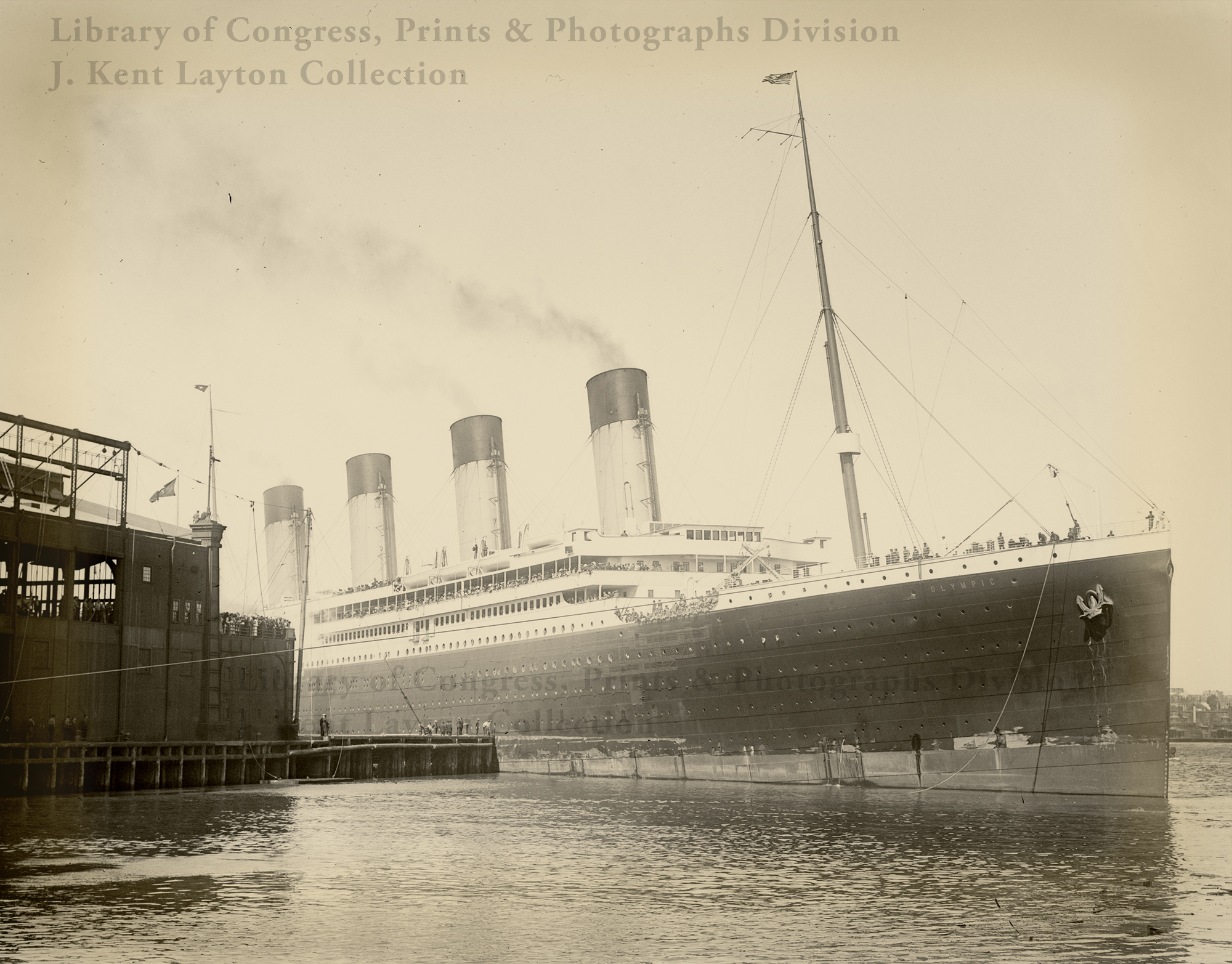
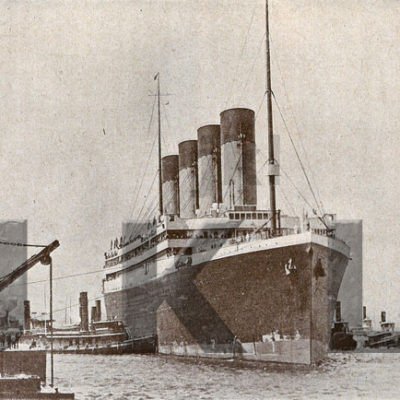
The White Star liner Olympic arrives in New York at the end of her maiden voyage. – Library of Congress, Prints & Photographs Division, J. Kent Layton Collection
The History of the RMS Olympic – A Brief Look:
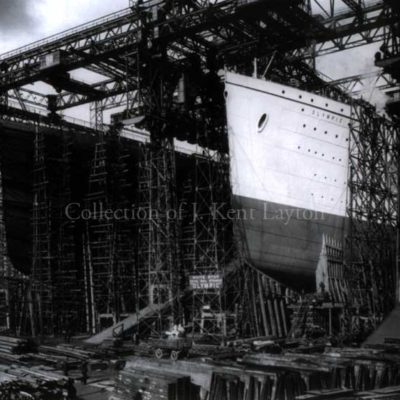
The keel for the Olympic, Harland & Wolff Yard No. 400, was laid on December 16, 1908 under the Harland & Wolff Shipyard’s new Arrol Gantry. It was here that she and her sister, Titanic, were built side by side. Titanic‘s progress trailed some months in the Olympic‘s wake, and would enter service some time after Olympic. The Olympic was launched on October 20, 1910, and when she started down the ways, she became the largest moving object in the world.
The Olympic – the world’s newest, largest and most luxurious ocean liner – made her maiden voyage on June 14, 1911. Aboard was J. Bruce Ismay, Chairman of the White Star Line and son of the Line’s founder. Also aboard was Harland & Wolff’s Thomas Andrews, nephew of Harland & Wolff’s Lord Pirrie. Captain Smith – who would go on to command the Titanic on her legendary and ill-fated maiden voyage the following year – was in command. The Olympic was so remarkable that by the time she had docked in New York, the formal order for the third entrant of the Olympic-class was placed.
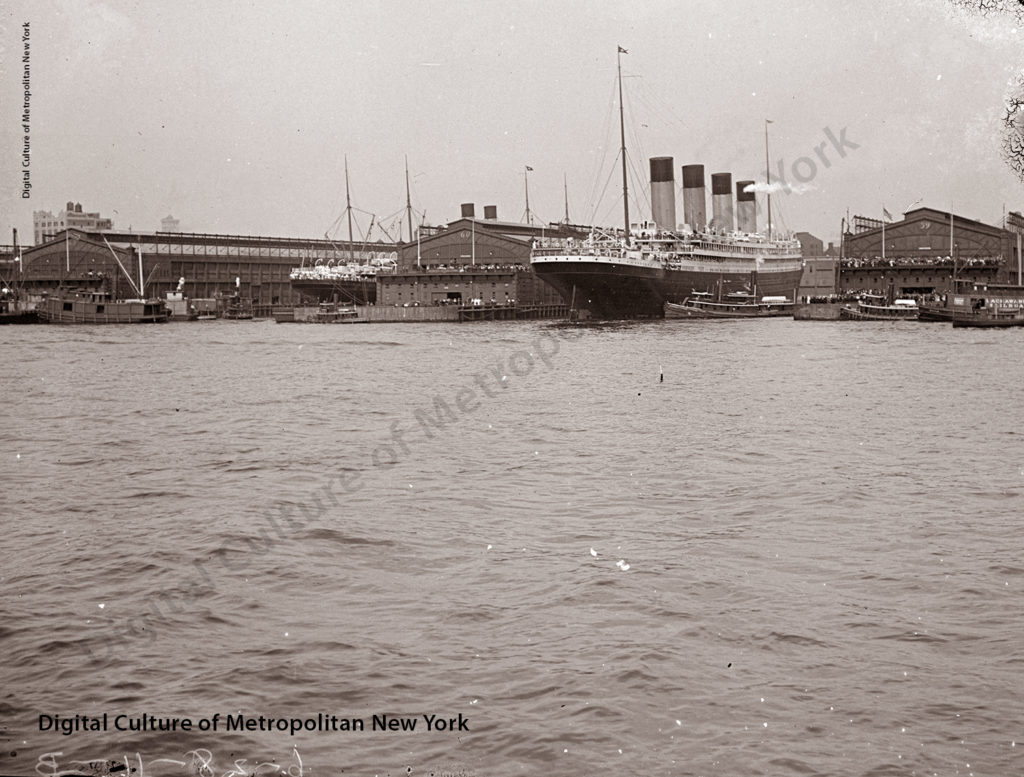
A tug pushes the Olympic into her New York pier for the first time on June 21, 1911. One of the “Big Four” – White Star’s previous generation of superliner – sits along the north side of Pier 60. The difference in size between the two ships shows just what a tremendous leap forward in size and scale the Olympic-class liner were. (Digital Culture of Metropolitan New York; click photo to be taken to their web site.)
During the following ten months, the Olympic garnered the lion’s share of the fame on the Atlantic. Her sister Titanic was not given anywhere near the amount of attention, simply because she was the second of the class. Only after she sank did the Titanic eclipse the Olympic’s fame.
Olympic made four round-trip voyages to New York and back to Southampton over the summer of 1911. Then, on September 20, 1911, she departed Southampton on what was to be her fifth west-bound crossing. As she proceeded toward the open sea, she encountered the HMS Hawke, a 360-foot long cruiser. The two vessels steamed side-by-side along a roughly parallel course, with the cruiser along the liner’s starboard side. At first, the smaller vessel was overtaking the Olympic, but then the Olympic‘s engine speed was increased, and the cruiser began to fall back. The suction from the larger ship’s propellers began to grow, and the Hawke was pulled bow-first into the starboard stern quarter of the Olympic. The Hawke‘s bow was crushed back, while the Olympic‘s hull was breached, and her two largest watertight compartments began to flood. Her crossing was canceled, and she limped back up to Belfast for repairs. The process kept her out of commission until the end of November. Once she returned to service, however, the Olympic proved that she was still a strong, reliable ship, even enduring severe punishment from the North Atlantic during a west-bound crossing to New York.
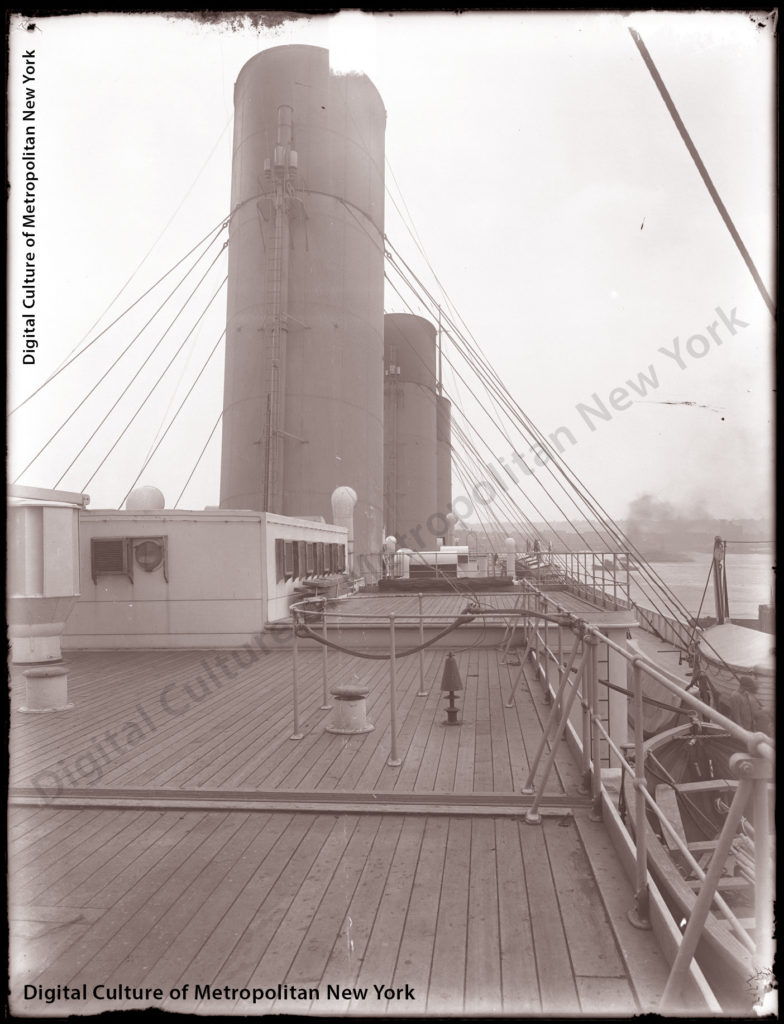
This photograph, taken looking aft along the roof of the Officers’ Quarters, shows the Olympic in New York, shortly after the Titanic disaster. Extra lifeboats are visible on the Boat Deck below. The housing for the dome over the First Class Grand Staircase is visible on the left, and some of the Marconi equipment is visible in the foreground. (Digital Culture of Metropolitan New York; click photo to be taken to their web site.)
Following the loss of the Titanic, it suddenly became clear that improvements would be needed in the watertight subdivision of the older sister in order to restore public confidence in her, and to make it so that she could withstand the same type of collision that sank the Titanic. The Olympic returned to Harland & Wolff for extensive modifications that included the addition of a new watertight bulkhead which divided her Electric Engine Room, the installation of an inner skin running the length of her Boiler and Engine Rooms, and the raising of several critical transverse bulkheads all the way to B Deck. During this refit, the Olympic was also endowed with several Titanic-like modifications, such as the Café Parisian, and she emerged slightly larger, at least in terms of gross registered tons, than Titanic had been in April of 1912.
Her career continued uninterrupted until the outbreak of the Great War in August 1914. Contrary to popular opinion, the ship enjoyed great success during 1913 and the first half of 1914, in spite of her intimate connections to the Titanic. It was clear that the upgrades and modifications to her design made after the loss of her sister, when coupled with extra lifeboats to accommodate all on board, were enough to help the traveling public feel confident in her safety.
After the outbreak of the Great War, she saw an extensive layup in Belfast, which was followed by distinguished service as a troop transport. The ship enjoyed great success in this guise, further cementing her reputation for reliability.
After the War, the ship underwent a large-scale refurbishment at Harland & Wolff, which included her conversion to an oil-firing powerplant. Then she was returned to commercial service. Throughout the 1920’s, she proved herself a solid, reliable vessel. But even the great Olympic could not survive the changing times. With the advent of newer, more modern-looking liners with more private bathrooms for their first class passengers, the Olympic began to look dated. When the Great Depression hit, this situation was made only worse as passenger bookings continued to decline. Nevertheless, the ship managed to help keep the White Star Line financially afloat.
Finally, the White Star Line was forced to merge with the Cunard Line on May 10, 1934. There was simply too many old ships in the newly combined fleet, and on April 12, 1935, she was laid up in Southampton. She went to the breakers and disappeared from the Atlantic scene forever. However, many of her furnishings and fittings were preserved, and can still be found today.
Olympic Pictures



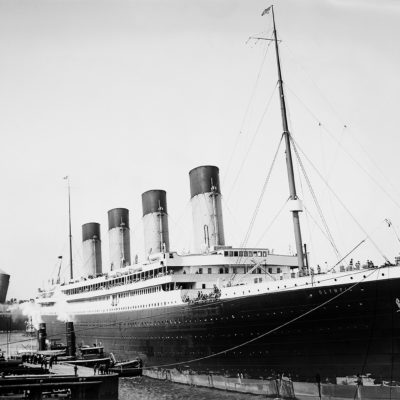


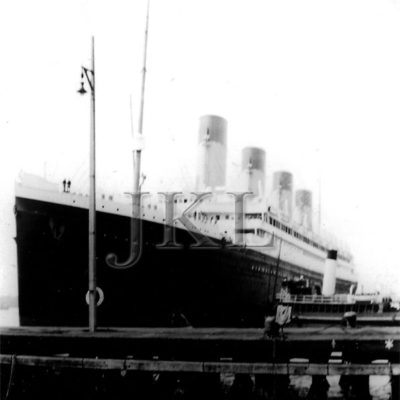


| Commanders of the RMS Olympic |
| Captain Edward John Smith – June 14 1911 – March 30, 1912 |
| Captain Herbert J. Haddock – March 30, 1912 – September 16, 1915 |
| Captain Bertram Fox Hayes – September 16, 1915 – January 7, 1922 |
| Captain Alexander Hambelton [*] – January 7, 1922 – end of January, 1923 |
| Captain Hugh David – End of January, 1923 – November 21, 1923 |
| Captain J. B. Howarth – November 21, 1923 – end of February, 1925 |
| Captain William Marshall – End of February, 1925 – September, 1928 |
| Captain Walter Parker – September, 1928 – end of 1929 |
| Captain E. R. White – Beginning, 1930 – ? |
| Captain John Binks – In command on May 15, 1934 (collision w/Nantucket Lightship) |
| Captain Reginald Peel – In command for final transatlantic voyage, March 27 – April 12, 1935 |
| Olympic Laid Up, Southampton – April 12, 1935 – October 11, 1935 |
| Captain P. R. Vaughan – October 11 – 13, 1935 (voyage to breakers) |
Olympic Today:
With the breakup and dismantling of the Olympic, many might have assumed that was the end of the line for her. However, while the ship as a whole certainly had met her end, her fittings and furnishings found new life.
When her lavish interior fittings and appointments were sold at auction in November of 1935, they each went in their own directions. Although some of them have been lost to time, many of them can still be seen today. These surviving fittings give us an opportunity to look into the past and get a glimpse of the Olympic’s grandeur – and hence that of her two sister ships.
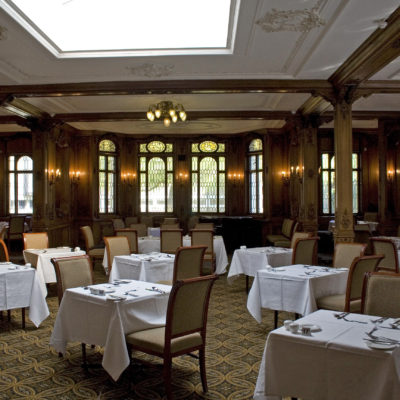
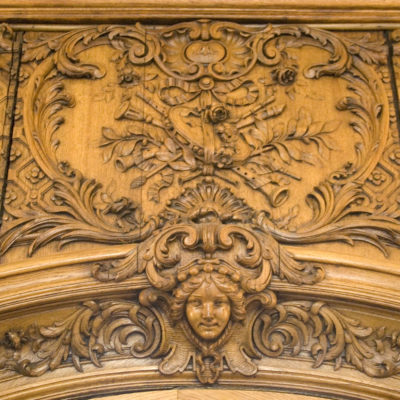
Perhaps the largest collection of interior fittings from the Olympic can be found in the White Swan Hotel, located in Alnwick, England. The paneling from the liner’s First Class Lounge was installed in the dining room of the hotel, giving a glimpse of the great beauty of the Olympic and her sisters, and of the hard work and craftsmanship that went into their fitting-out. In addition to the paneling from the Lounge, the White Swan also boasts the revolving door that led from the First Class Smoking Room aft to the port Verandah Café. There are also oak balustrades from the First Class Grand Staircase lining the various staircases within the hotel, while lead and stained glass windows as well as wall sconces from the liner light the dining room. Some of the overhead light fixtures from the Olympic’s Grand Staircase and the First Class Smoking Room have also found their way there.

This photograph shows the Olympic‘s First Class Lounge repurposed as the dining room of the White Swan Hotel. Here, it is “dressed” for a special occasion, perhaps a wedding reception. (Courtesy of the White Swan Hotel)
A selection of images taken at the White Swan Hotel, courtesy Wikimedia Commons:




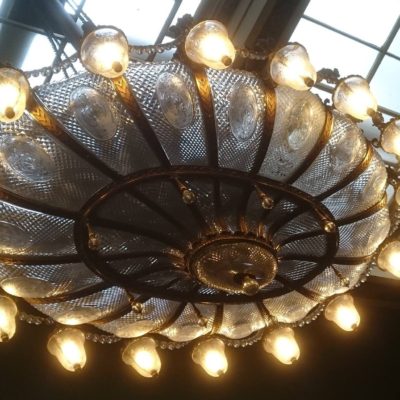
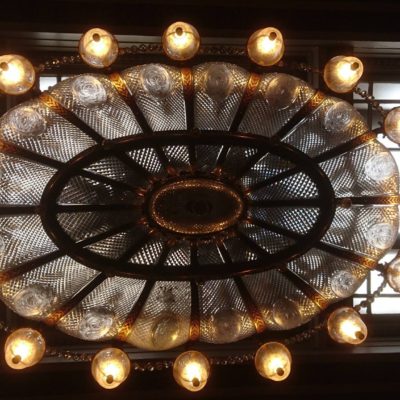
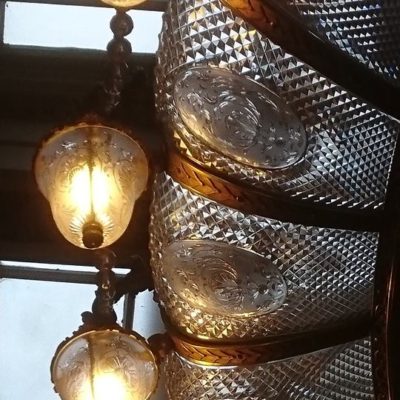
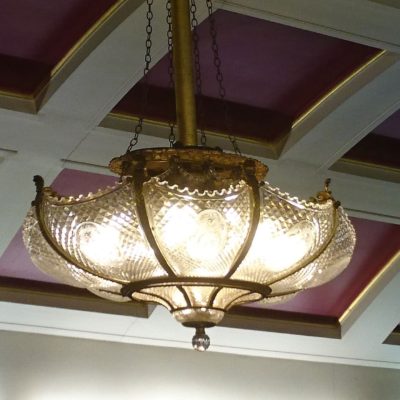
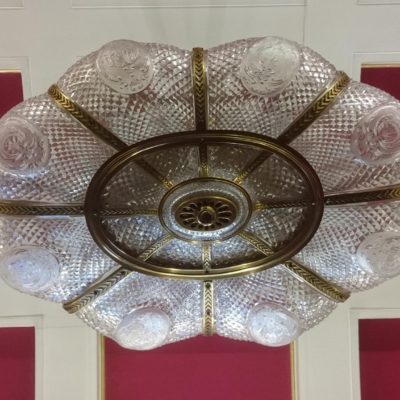
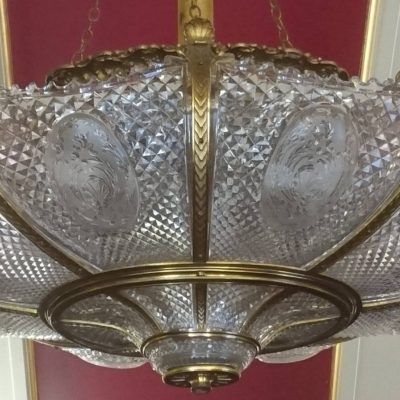
Another location that holds some fittings from the Olympic is Cutler’s Hall, in Sheffield. They bought the massive ormulu electrolier from the Olympic‘s Lounge – one of only two such fittings ever made, with the other having gone down with the Titanic – as well as the four smaller oval electroliers, and some of the paneling from the Second Class Lounge. On a recent trip there, Pavel Chlupac took a series of photographs of some of these fittings, which he has kindly shared with me for display here.








Private collectors also hold much material from the Olympic. Fifty years after the ship was scrapped, some of the ship’s oak woodwork was found in a barn in Northern England, and it as promptly put up for sale. Every now and then, one can even find Olympic material up for auction in a way that could never have been dreamed of when her fittings were originally auctioned off: over the internet. There, bidders can view the objects from the comfort of their living room or office, and can place bids against people from completely different countries. Because one cannot see the items first-hand, however, potential bidders should always remember the age-old adage of “buyer beware”.
For those not interested in bidding at auctions – either in person or via the internet – there is another, and perhaps most satisfying way of seeing a part of the Olympic today. The Royal Caribbean Cruise Line has always been notorious for the great expense they lavish on creating luxurious spaces aboard their ships. In this, they follow the footsteps of the White Star Line. Royal Caribbean, also called RCCL, recently introduced a cruise ship called Millennium into their family fleet of monster ships. Aboard the Millennium, in one of the dining rooms, the company decided to install the intricately inlaid walnut paneling and leaded glass from the Olympic’s First Class á la carte Restaurant.
Remarkably, nearly a century after the Olympic was first conceived, one can still sit on board an ocean-going vessel and soak in the ambience of the great liner and her two lost sisters. Through the deck comes the tremor of the ship’s engines – although driven by diesel engines instead of coal- or oil-fired boilers and reciprocating engines, there is a certain warmth, comfort, and vitality that comes with that vibration. There is still the chatter of passengers, and clatter of fine china and crystal, the gentle sway of the ship as it works its way through the waters.
Even more recently, a batch of five windows from the Olympic’s First Class Lounge have been acquired by the Nomadic Preservation Society and brought to Belfast to display aboard White Star’s last surviving ship.
Today, the remnants of the Olympic, first of the great White Star trio, still offer glimpses into the past, into the beauty that she offered when she was the “Old Reliable” of the North Atlantic passenger ferry, and still give us a connection to her tragically famous sister, R.M.S. Titanic.
Please follow these hyperlinks to find information on the Nomadic. She was built by Harland & Wolff to serve as a tender for the Olympic and Titanic at the port of Cherbourg, France.
Please follow this hyperlink to find information on the Titanic, and click here for information on the Britannic.
Please click here to see a list of FAQs regarding the Titanic, some of which apply also to the Olympic.
_______
[*] Displacement of the Olympic-class ships:
The displacement (or the weight of the seawater that the ship would displace, an estimate of literal weight rather than of enclosed space) of the Olympic and Titanic have often been cited at “66,000 tons”. Researcher Mark Chirnside has recently developed an excellent article, “The 66,000 Ton Myth”, that proves this figure inaccurate. What was the actual displacement for the Olympic and the Titanic, then? (Note: The Britannic‘s displacement was slightly greater due to her larger beam and other modifications made to her design.)
Since the weight of the vessel would vary depending on her load status (i.e., fuel, cargo, provisions, etc.), the measurement of 52,310 tons (British tons of 2,240 pounds, or just over 117 million pounds) cited above would apply to the ship at a draught of 34′ 7″. At a draught of 27′ 10 1/2″, she displaced 40,850 tons; at a hypothetical draught of 36’ (deeper than her standard in service load), she would still displace less than 55,000 tons. The displacement of the Titanic at 34′ 7″ was quoted by Edward Wilding at the British Inquiry as being identical to the Olympic at the same draught.
For further information on where the 66,000-ton displacement figure came from, please see Mark’s entire article here.
[#] Frequently, Captain Hambelton’s name is spelled “Alec Hambelton” or “Alec Hambleton.” A relative of his, however, was kind enough to provide me with the correct spelling of his name: Alexander Hambelton.