
RMS Titanic Home

This very rare photograph shows the Titanic on the evening of Monday, 8 April 1912. Workmen are repainting her funnels. (Chirnside / Layton / Klistorner Collection)
| Ship Statistics: | |
| Built By: | Harland & Wolff |
| Yard Number: | 401 |
| Length Overall: | 882 feet 9 inches |
| Length Between Perpendiculars (b.p.): | 850 feet 0 inches |
| Width: | 92 feet 6 inches 94 feet to extreme edges of Boat Deck |
| Draught: | 34 feet 6 inches |
| Gross Tonnage: | 46,328.54 |
| Displacement: | 52,310 at 34 feet 7 inches* |
| Career: | April 10-15 1912 – Sank |
| * See FAQ section |
Titanic Data Sheet for Media Inquiries, 2023
Click here to see some important Titanic FAQ’s.
Click here to see a Titanic timeline.
The History of the RMS Titanic:
The Titanic was intended to be the second of the Olympic-class liners. No one could have predicted, however, that she would end her career only five days into her maiden voyage, and that she would become the most famous Atlantic liner of the twentieth century.
She started life as Harland & Wolff Hull No. 401, and was built alongside her older sister. At the time of her launch, on May 31, 1911, she was virtually indistinguishable from the Olympic. During her fitting-out process, however, some changes were made to her design that made her slightly larger in enclosed space than the Olympic (some 1,004 “tons”, to be exact). Her B Deck staterooms were increased in number, effacing the Enclosed First Class Promenades and changing her exterior window configuration. Her First Class Restaurant was increased in size due to the popularity of the Olympic‘s Restaurant. A new French sidewalk cafe termed the “Café Parisien” was installed on the starboard side of the Restaurant. Down below, on D Deck, the First Class Reception Room was enlarged. Above, on A Deck, the ship’s forward Promenade Deck was screened off with square sliding windows to protect passengers from the elements. To prevent foul weather and winds from funneling down the length of the deck, a bulwark was erected just under the port and starboard Bridge wings which contained both a door and window each.
The Titanic‘s fitting-out was interrupted twice by the Olympic, and this eventually delayed her maiden voyage from March 20 to April 10, 1912. Her sea trials were scheduled to take place on April 1, but due to bad weather these were delayed to April 2. They were carried out over the course of several hours, and the ship passed with flying colors. Her passenger certificate was signed, ‘good for one year’ – and this despite the fact that the ship carried enough lifeboats for only 1/3 of her potential full capacity of passengers and crew.
The ship sailed down to Southampton that evening. Over the course of the following days, final preparations were made to complete the ship and ready her for the maiden trip. This included ensuring that she had enough coal for her trip, a difficulty since a coal strike that had nearly crippled the British shipping industry had only just ended. The Titanic had a normal coal-carrying capacity of 6,611 tons (an additional 1,092 tons could be carried in a reserve coal bunker). By the time the Titanic left, those in charge of the matter had managed to provide her with 5,892 tons of coal. This meant that the ship had 89.12% of her ordinary coal carrying capacity on board when she left Southampton on April 10. These calculations finally lay to rest the myth that the Titanic was short of coal during that abortive voyage.
During the morning of Wednesday, April 10, the ship took on her first – and, it would turn out, her only – batch of passengers and crew. She left shortly after noon, and the maiden voyage nearly ended before it even began; as she passed the tied up liner New York, the suction from her passage through the water drew the smaller liner away from her pier, parted her lines and almost made her collide with the behemoth. Only quick action by the Harbor Pilot and Captain, as well as tugboats on the scene, prevented the collision.
That this collision was averted turned out, in the long run, to be a tragedy in and of itself.
The ship called briefly at Cherbourg, France that evening, to off-load some cross-channel passengers and to pick up more passengers and mail, and then called at Queenstown (now Cobh) Ireland the next morning.
By the time the Titanic left Queenstown that afternoon, there were 2,208 passengers and crew aboard. As she progressed westward, her speed was gradually increased. Her daily runs were as follows:
- 484 miles, noon Thursday to noon Friday
- 519 miles, noon Friday to noon Saturday
- 549 miles, noon Saturday to noon Sunday
Although no run was officially taken from noon Sunday to noon Monday (for obvious reasons), it is quite clear from passenger testimony that by Sunday evening, the ship had sped up again. According to those on duty at the time of the collision, all 24 of her ‘main’ boilers were operating at full pressure, and the ship was making about 22 1/2 knots according to the Cherub Log. A ‘full speed’ test had been agreed upon for Monday by the ship’s Captain and White Star’s Managing Director, J. Bruce Ismay, and there is clear evidence to show that there was a plan to – weather permitting – bring the ship into New York on Tuesday night rather than Wednesday morning.
Especially during Sunday, April 14, numerous ice warnings came into the ship via wireless. Even so, there was no diminution of speed. The results were predictable, if catastrophic: at 11:40 pm (ship time) Titanic struck an iceberg. Six small areas of damage were punched in her forward, starboard hull plates, and water began entering her forward six compartments. Her forward five compartments were flooding uncontrollably, and her designer, Thomas Andrews predicted that she would be able to remain afloat for an hour to an hour and a half.
Work quickly began on lowering the lifeboats. The best-researched timeline for the lifeboat launching work can be found in the newly-revised article, “Titanic: Lifeboat Launching Times Re-Examined,” by Bill Wormstedt, Tad Fitch and George Behe. Make sure to view the article to see the results of their research for yourself. By the time the Titanic sank at 2:20 am (ship’s time), only 712 of her 2,208 passengers and crew had been safely evacuated. 1,496 perished in the icy seas that night. (Please note that these figures are based upon the reliable research of Lester Mitcham, co-author of Titanic: A Centennial Reappraisal, and represent the most accurate analysis of the number aboard the doomed ship, and of those rescued.)
The wreck of the Titanic was discovered on September 1, 1985 by Dr. Robert D. Ballard in a joint U.S.-French expedition. Over subsequent years, salvage efforts have recovered hundreds of items from the site, and three expeditions by film director James Cameron have added immeasurably to the collective wealth of knowledge about the Titanic. Sadly, it has become clear that the wreck is beginning to give way to the elements and is deteriorating rapidly.
A renewed wave of interest in the Titanic followed the December 19, 1997 release of James Cameron’s film “Titanic“, which became the highest-grossing box office film up to that time. Although the peak of interest has subsided somewhat, the overall public’s interest remains heightened and shows very little signs of letting up; there is just no quenching the public’s thirst for knowledge about the legendary liner. In October of 2005, Cameron released a Special Edition DVD which included many of the historical deleted scenes from the ’97 film. On April 6, 2012, the film was re-released in theaters, to commemorate 15 years since the original release as well as the centennial anniversary of the disaster.
On May 31, 2009 the last living survivor of the Titanic disaster, Millvina Dean, passed away. She was 97 years of age.
Every year on 14-15 April, my co-authors from On a Sea of Glass: The Life & Loss of the RMS Titanic and Recreating Titanic and Her Sisters: A Visual History join Tom Lynskey of HFX Studios to do a real-time commemorative event on his YouTube channel, Part-Time Explorer. The animation that we used in 2021, 2022, and 2023 was made by HFX Studios’ staff to our specifications, based on our decades of research. To our knowledge, it was the first time historians had been put in the driver’s seat for any major reconstruction of the disaster. During the 2023 livestream, our panel was joined by historian George Behe and visual historian Ken Marschall. Our livestream ran for nearly six hours, and we were able to cover a lot of fantastic historical ground. It can be seen here:
If you prefer to watch the 2021 real-time animation with sound effects instead of our historians’ panel chatting, you might want to watch this version here:
Recommended Titanic books or research papers:
Below you will find a list of some of the more recent volumes touching on the history of the Titanic, which I was privileged to have a part, or in some cases a very small part, in contributing to.
Now available:
 In honor of the centennial anniversary of the disaster, On A Sea of Glass: The Life & Loss of the RMS Titanic was prepared. Co-authored by Tad Fitch, J. Kent Layton and Bill Wormstedt, it has proved to be one of the most groundbreaking and inclusive publications on the subject ever published. The book is now in its fourth edition.
Report Into the Loss of the SS Titanic: A Centennial Reappraisal: After years of working behind the scenes with researchers such as Sam Halpern, Mark Chirnside, George Behe and most of the other co-authors listed for this volume, I was asked to participate in a small way in the new book, Report Into the Loss of the SS Titanic: A Centennial Reappraisal. Given an advance copy of the manuscript and pre-press layout, I was asked if I would consider contributing an Introduction to the book after considering the merit of its contents. As I went through the book, it became apparent that this was going to be a fantastic look at the disaster from an analytical perspective. It was so fresh and well put together that I did not hesitate to agree to pen the Introduction. Make sure to have a look at this splendid volume! (Note: The publisher dropped the subtitle “A Centennial Reappraisal” in revised printings, which has caused no small amount of confusion for readers.)
Titanic in Photographs: Daniel Klistorner, Steve Hall, Bruce Beveridge, Scott Andrews and Art Braunschweiger are among the most widely respected historians of the Titanic – particularly in regard to aspects of the vessel’s technical design and visual appearance. This collaborative effort presents a stunning visual record of the lost liner. More details here.
Lifeboat Launching Sequence and Timeline: From the time of the initial inquiries into the disaster, attempts were made to establish the time of launch for each of the ship’s twenty lifeboats. What time did the first one, Boat No. 7, depart? In what order were they lowered away from the deck? Is it likely that the first lifeboat was lowered away far earlier than has been previously supposed, or does a preponderence of the evidence support a timeline closer to that which was arrived at by the formal inquiries? Separate fact from fiction in the newly-revised article, “Titanic: The Lifeboat Launching Sequence Re-Examined,” by Bill Wormstedt, Tad Fitch and George Behe. This article was originally published in The Titanic Commutator, in abridged format, but undergoes continuous refinement and expansion by the authors online. As you will see, the most in-depth research on the subject has turned up some startling evidence.
The Titanic & The Californian: Perhaps more than any other aspect of the Titanic story, this subject sparks the most debate, controversy, and even ill-will among Titanic researchers. The most succinct, accurate and inclusive article on the subject presented to date is authored by veteran Titanic researcher Sam Halpern. Follow this link to read “Rockets, Lifeboats, and Time Changes.”
I was pleased to be a part of the research group the developed the above articles or books.
Titanic Gallery
A selection of Titanic images for you to enjoy.
This video is of the Titanic in the Belfast Graving Dock. Her B Deck window configuration has already been changed, but her A Deck Promenade remains open.
Further Information on RMS Titanic:
| Commanding Officers of the Titanic, April 10-15, 1912 | |
| Captain | Edward John Smith, R.N.R. |
| Chief Officer | Henry T. Wilde |
| First Officer | William McMaster Murdoch |
| Second Officer | Charles H. Lightoller |
| Third Officer | Herbert J. Pitman |
| Fourth Officer | Joseph G. Boxhall |
| Fifth Officer | Harold Godfrey Lowe |
| Sixth Officer | James P. Moody |
Controversial Points:
There always have been and always will be questions about what really happened on the night that the Titanic met her horrible fate. Many of these questions have been answered by the two formal investigations into the disaster, or over the years by various historians and scientists, who all add their findings into the collective story of the ship’s loss. Other questions can only be answered with new scientific discoveries and forensic analysis made on the wreck today by various organizations and science teams. Many more are not answerable, and we only have a few tantalizing clues as to the truth about what took place.
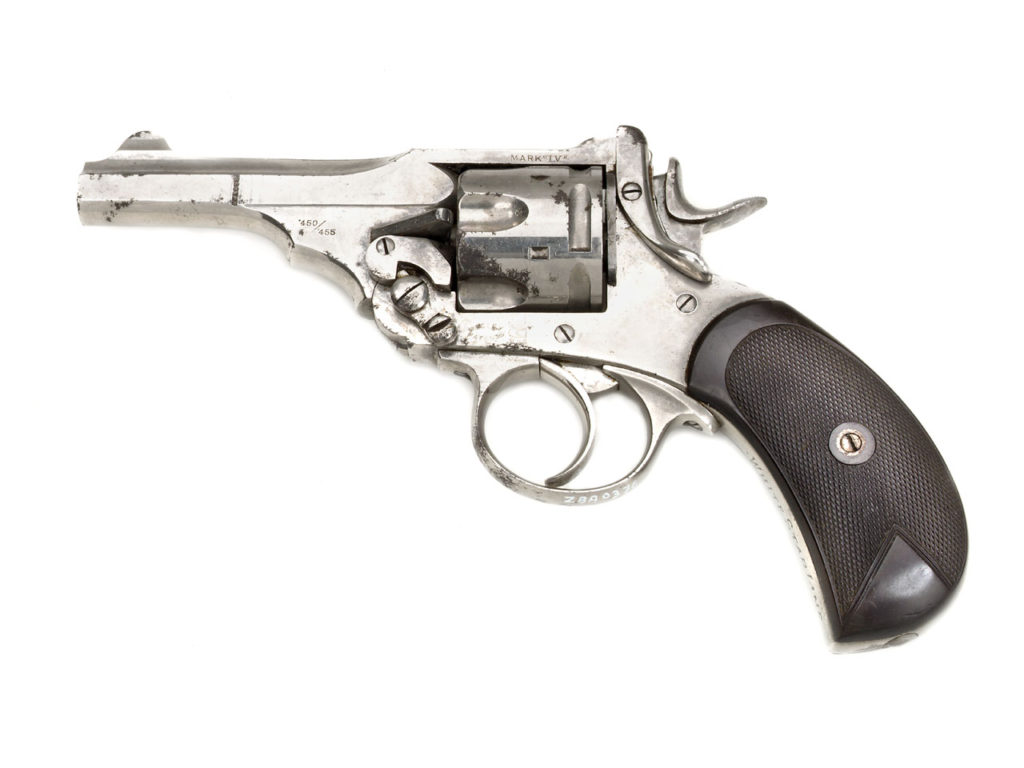
This Webley Mark IV revolver is in the collection of the National Maritime Museum in Greenwich, England. (Click the image to be taken to the item’s page.) On the barrel is “White Star Line”. Similar revolvers were likely those available to Titanic‘s officers on the night of the disaster. (©National Maritime Museum Collections)
However, if one carefully pieces the evidence from numerous eyewitness accounts and recent scientific discoveries together, it is surprising how much can actually be ascertained about some of these matters. The truth that one discovers in the process can sometimes be just as surprising. Research on such topics as the iceberg damage, the band’s actions during the sinking, what their last song was, the incidents of gunfire during the sinking, and many others, can all be found in On A Sea of Glass: The Life & Loss of the RMS Titanic.

New plans of the Titanic, created by Cyril Codus; click thumbnail to enlarge. (Courtesy Cyril Codus)
Perhaps all of these controversial matters, and all of the what-ifs associated with the great ship and her sinking are a part of the reason why the ship has fascinated so many for nearly a full century. Even now, there is a massive interest in the ship and in the people that sailed aboard her. Certainly, the Titanic disaster has become legendary as a symbol of man’s arrogance falling before the whims of nature, and she was an object lesson that is still as modern as the day she sank. That lesson is still felt every time there is an airplane crash, another sea disaster, an earthquake or a flood – and even on September 11, 2001.
Her legendary status has evoked more attention than any other Atlantic liner has ever received, and nine decades after the tragedy, we are still fascinated by her life and loss. Why? Because it’s the Titanic…
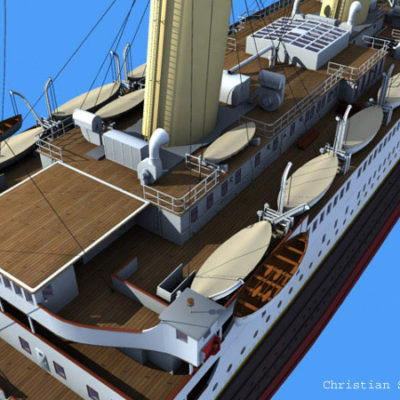
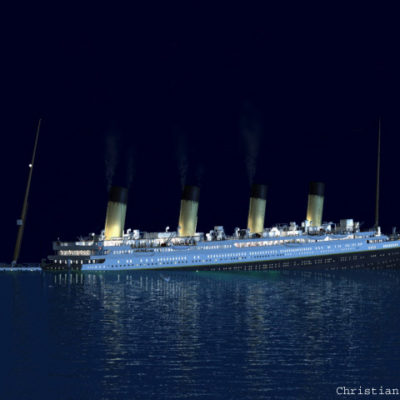
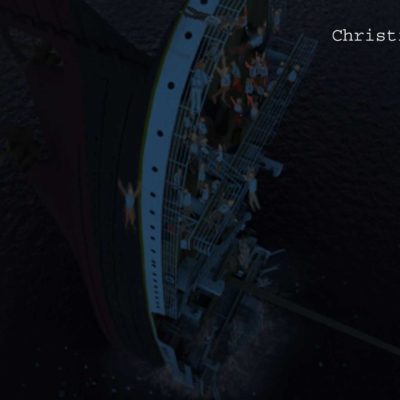
Some years ago, digital and graphic artist Christian Stenfelt created a series of fantastic pieces of artwork showing Titanic during her maiden voyage and sinking. I am happy to show his work, which has proved very popular over the years.








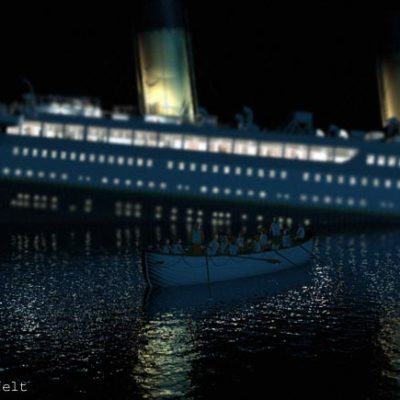


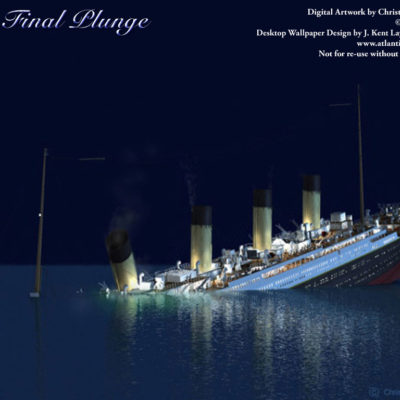

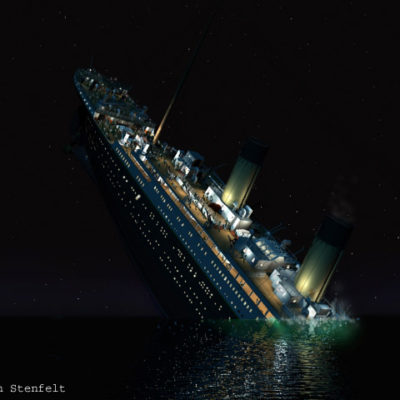

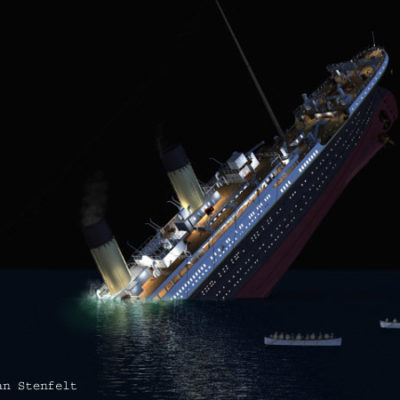



Please note: it is impossible to place much of the supporting evidence for these answers in a few brief pages on my site. Instead, these findings are based on the research that is included in each of my books. Please go to my Books page in order to learn more about each of these volumes, so you can have a more in-depth look at the facts for yourself.
 |
Titanic: Solving the MysteriesIn the pages of this November 2019 hardback book, our team of historians and authors tackles two vital questions to understanding the Titanic disaster: did a coal bunker fire contribute to the sinking? And how much time separated shipboard time on Titanic from time ashore in places like New York or London? This book is not available on Amazon or in bookstores anywhere; it can only be purchased through the publisher direct through this link!
|
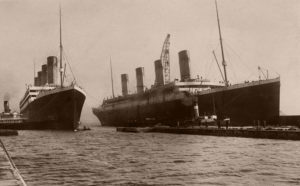 |
Titanic: Switched at Birth?Were the Titanic and her sister ship, Olympic, switched as part of some sort of conspiracy? |
 |
Penny-Pinching, Cut Corners, & Shoddy Ships?Was the strength of Titanic‘s hull insufficient or of a poor design? Had someone pressured Harland & Wolff to build the ships “on the cheap” to save money? |
 |
A Numbers GameExactly how many people were aboard Titanic when she sank? How many died, and how many lived? |
 |
The “Bump In Mid-Ocean”: A Grounding, Or A Sideswipe?Did Titanic sideswipe the iceberg? Or ground on it? |
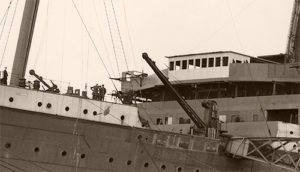 |
The “Big Ship”What was Titanic‘s displacement? |
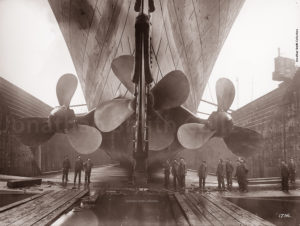 |
The Propeller Blade MysteriesHow many blades did each of Titanic‘s three propellers have? What size were each of her propellers? Yes, there is a twist in the answer most Titanic buffs think they know! |
 |
The Record Set Straight:
|

Above: This photograph shows an authentic piece of paneling from the TItanic‘s First Class Lounge. Originally, it stood over the double doors leading aft from the Lounge toward the aft Grand Staircase. It was found in the sea shortly after the sinking, almost certainly torn loose as the ship broke up, and now resides in the Maritime Museum of the Atlantic in Halifax, Nova Scotia. You can compare this piece of Titanic with the panel from the same location on the Olympic, which now resides in the White Swan Hotel in Alnwick, England, There are both similarities and minor variations (Olympic‘s panel is shown below for comparison).
As an aside, this recovered piece of Titanic‘s paneling was the basis for the piece of “hero” paneling that saved the character Rose in James Cameron’s 1997 film Titanic. Although commonly referred to as a “door”, that is incorrect–it was deliberately designed as a near-match for this piece of paneling, which originally sat above the doors that gave access to the room, and which was probably torn loose and floated away as the liner broke up. (This photo of Maritime Museum of the Atlantic is courtesy of TripAdvisor)

This is Olympic‘s Lounge panel – a nearly-perfect match for the piece recovered from the Titanic wreck site, seen above, although there are subtle variations. (Courtesy Wikimedia Commons)
Please click here to go to the Olympic‘s Home Page.
Please click here to go to the Britannic‘s Home Page.
Please click here to go to the Nomadic‘s Home Page.