S.S. Vaterland / S.S. Leviathan Home

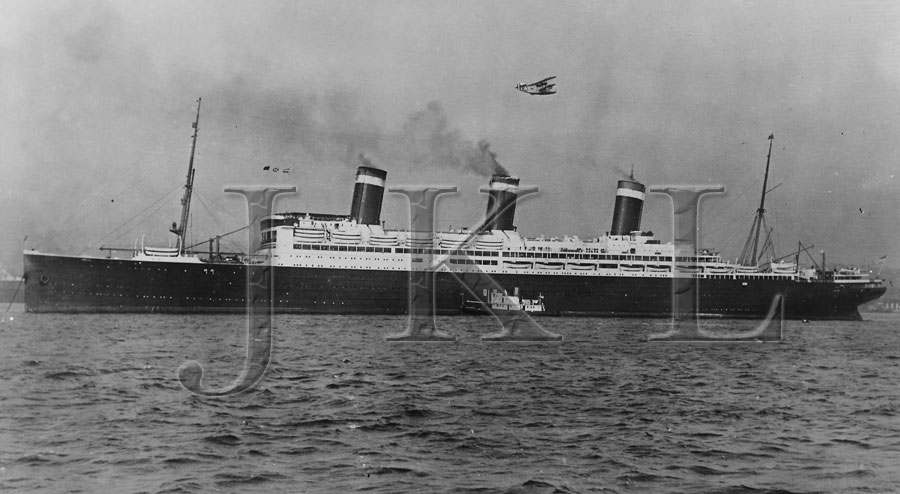
This photograph shows the German liner Vaterland in early 1914. (J. Kent Layton Collection)
| Ship Statistics: | |
| Built By: | Blohm & Voss |
| Yard Number: | 212 |
| Length Overall: | 950 feet |
| Length Between Perpendiculars (b.p.): | 912 feet |
| Width: | 100 feet |
| Draught: | – 37 feet 0 inches – Later increased as Leviathan |
| Gross Tonnage: | – 54,281.718 (1914) – 59,956 (1923) – 48,590 (1931) |
| Displacement: | app. 66,800 tons at 40 feet 0 inches |
| Career: | May 14, 1914 – December 1937 – Scrapped |
The History of the Leviathan:
The ship that was well-known as the United States Line’s Leviathan during the 1920s and 1930s actually started life as the second of the great Hamburg-Amerika trio. While her predecessor had been built at the Vulkan yards, Vaterland was laid down at Blohm & Voss’ Hamburg shipyard as Hull No. 212.
Her real beauty, shared with her sister to follow, was not just in her size and remarkable powerplant, but also in her First Class interior spaces. Although the general decor and layout remained similar to her predecessor, she and the later Bismarck were designed with split funnel uptakes. This allowed for a central vista down the long axis of the ship, most notably through all of the B Deck public rooms, which from an architectural standpoint made for a tremendous improvement over her sister Imperator.
On her trials, which spanned April 29 and 30, the ship developed an astonishing 90,400 shp (shaft horsepower), and achieved a speed of 26.3 knots. This led some to believe that this vessel might have the capacity to take the Blue Riband back from the Mauretania. In the end, however, the Vaterland never took the trophy from her British rival, although she did prove to be a remarkably swift liner.
The Vaterland entered service, starting her maiden voyage to New York on May 14, 1914. In total, she made three round trips between Europe and New York. After making her fourth west-bound crossing to New York, the Great War started. Suddenly, she was caught in the port of a neutral nation, with British warships waiting on the Atlantic route for her to try and make a run for it.
In the end, Vaterland stayed in New York until the United States entered the war, at which time she was seized by the government; her crew, although ordered to damage the ship so that she could not be reused, had apparently been so attached to the liner that they could not bring themselves to ruin her.

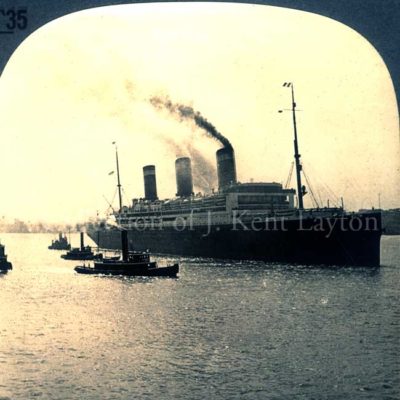
The Leviathan, dazzle painted, apparently departing her Hoboken Pier, and under the escort of a veritable flotilla. (J. Kent Layton Collection)
She was officially taken over by the U.S. Navy on July 25, 1917. One of the first things that needed attention was a change of name: “vaterland” was simply too reminiscent of her German origins. It was President Woodrow Wilson himself who suggested that she be renamed Leviathan, and the formal name change took place on September 6, 1917.
Her conversion into a troopship lasted some seven months, and she was not able to begin her first trooping voyage until December 14, 1917. By the time the Armistice was signed, on November 11, 1918, the Leviathan had made 19 crossings and carried over 100,000 American doughboys to the fronts. By any measurement, her career as a troopship was very successful. She was next engaged in repatriating war-weary American troops back to the United States, returning them to their homes and families.

This photograph of the Leviathan was taken during World War One, while she was serving as a troop transport for the Americans. Her badly kept-up appearance and faded “dazzle” paint scheme are merely superficial. The ex-Vaterland will have a career in peace once again. (J. Kent Layton Collection)
After the war, the liner was laid up at her pier in Hoboken, New Jersey, on the Hudson River. She did not leave there again until April 9, 1922, when she started out for a thorough overhaul and refit at Newport News, Virginia, under the watchful eye of naval architect William Francis Gibbs. Leviathan entered service with the United States Lines on July 4, 1923.

An original painting by Charles Wilson, showing the Leviathan under escort from tugboats. (From the Collection of the Peabody Essex Museum. Used with permission.)
As the flagship of the U.S. Lines, she was touted as the “world’s largest ship,” for her gross tonnage had been remeasured as 59,956, instead of her previous 54,282. Her longer, larger sister, the Majestic was actually registered at only 56,551 tons. On the surface, it might appear that the Leviathan had somehow managed to gain 5,674 gross tons of space (“space”, and not “weight”, as gross tonnage is actually a measurement of enclosed volume) during her conversion, and that she was now some 3,405 tons larger than her sister. However, the real reason that her gross tonnage was so inflated was because of the differences between the British and American systems of measuring gross tonnage. In reality, the Majestic was still the larger of the two ships.
Throughout the 1920s, the Leviathan proved to be a very popular ocean liner. In 1927, for example, she carried more passengers than did her two former sisters, Majestic and Berengaria, and in 1929, she carried more passengers than any other liner. However, she was significantly hampered by the lack of suitable running mates to set up a balanced service. She was also, during the madness of “Prohibition” in the United States, a “dry ship,” which tended to motivate thirsty Americans toward ships registered with Great Britain featuring bars stocked full of liquors.
With the onset of the Depression in late 1929, things grew dark for the Leviathan‘s management. She spent much time between 1935 and 1938 laid up in Hoboken, and in January of that year was sold for scrap. Had she been under different management, or paired with more suitable running mates during her career, she might have outlasted both of her previous sister ships and found use during the Second World War.
Recommended Reading on the Leviathan:
In addition to my own chapter on the Leviathan in The Edwardian Superliners: A Trio of Trios, there is not much material available on this all-too-forgotten ship available. The notable exception to this vacuum is a remarkable 6-volume set of oversize books on the ship entitled, The Story of the Leviathan: The World’s Greatest Ship, by maritime historian Frank O. Braynard.
These books cover the ship and her history from top to bottom, bow to stern, and are unparalleled in books on maritime history. If you have interest in the Leviathan, this is the set to get. Save your pennies, though, because this out-of-print set is not cheap.
Vaterland / Leviathan Images